UP Super TET · Question 21
शैले शैले न माणिक्यं मौक्तिकं न गजे गजे। साधवो न हि सर्वत्र चन्दनं न वने वने॥ अस्मिन् श्लोके सर्वत्र के न भवन्ति?
Show answer & explanationShow explanation
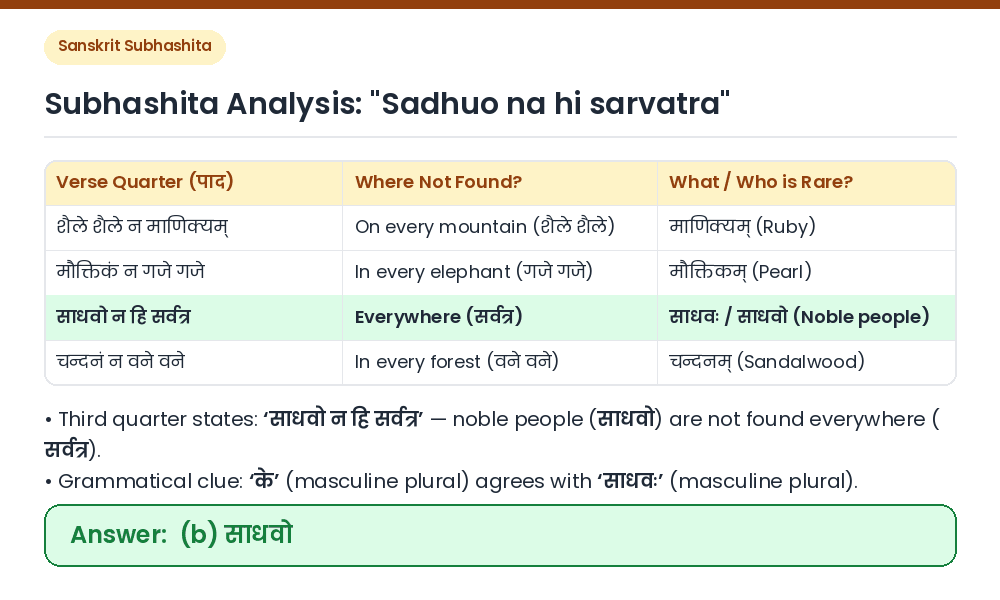
Answer: (B) साधवो
Rule & Verse Meaning: This famous Sanskrit Subhashita (attributed to Chanakya Niti) states that precious things are rare—not every mountain has a ruby, not every elephant has a pearl, noble people (साधवः/साधवो) are not found everywhere (सर्वत्र), and sandalwood is not found in every forest. Application: The question asks 'अस्मिन् श्लोके सर्वत्र के न भवन्ति?' (In this verse, who are not found everywhere?). Line 3 directly answers: 'साधवो न हि सर्वत्र' — noble/virtuous persons (साधवो) are not found everywhere. Grammatically too, 'के' (masculine nominative plural) matches 'साधवः' (masculine nominative plural of साधु). Why other options are wrong: • (a) मौक्तिकम् (Pearl): Not found in every elephant ('न गजे गजे'); neuter singular. • (c) माणिक्यम् (Ruby): Not found on every mountain ('शैले शैले न'); neuter singular. • (d) चन्दनम् (Sandalwood): Not found in every forest ('न वने वने'); neuter singular. Correct Answer: (b) साधवो