UP Super TET · Question 30
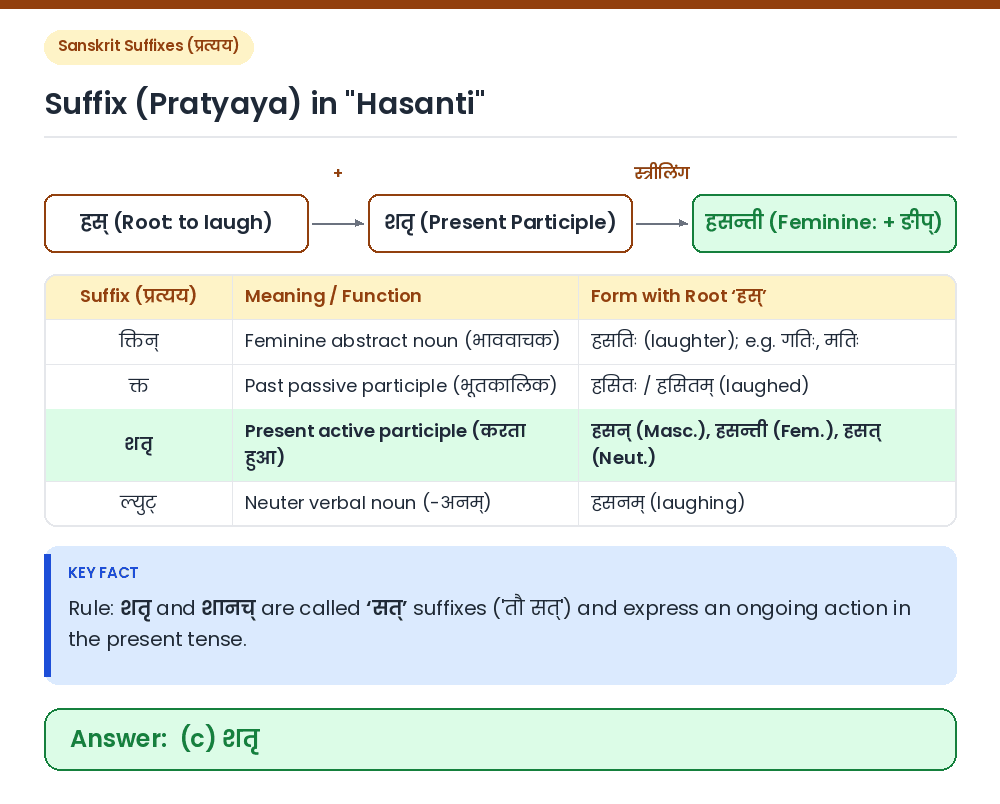
‘हसन्ती’ पद में प्रत्यय है
Show answer & explanationShow explanation
Answer: (C) शतृ
Rule: The Krit suffix 'शतृ' (whose residual part is 'अत्') is added to Parasmaipadi verb roots in the sense of the present continuous participle ('लटः शतृशानचावप्रथमासमानाधिकरणे' — 'while doing / laughing'). Application: Adding 'शतृ' to the root 'हस्' (हसँ हसने — to laugh) gives the stem 'हसत्' (Masculine: हसन्, Neuter: हसत्). In the feminine gender, the suffix 'ङीप्' (ई) and augment 'नुम्' (न्) are added to form 'हसन्ती' ('she who is laughing'). Why other options are wrong: • (a) क्तिन्: Forms feminine abstract nouns ending in '-तिः' (e.g., कृतिः, गतिः, मतिः). • (b) क्त: Forms past participles (निष्ठा) ending in '-तः/-ता/-तम्' (e.g., हसितः, पठितः). • (d) ल्युट्: Replaced by 'अन' ('युवोरनाकौ') to form neuter verbal nouns (e.g., हसनम्, पठनम्). Correct Answer: (c) शतृ