UP Super TET · Question 62
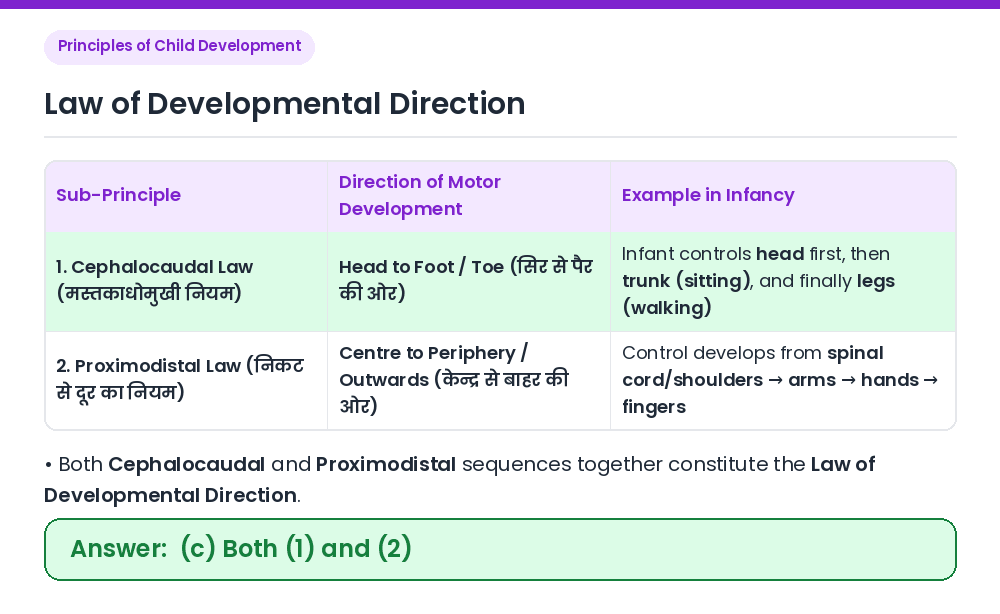
The law of developmental direction includes
Show answer & explanationShow explanation
Answer: (C) Both (1) and (2)
The Law of Developmental Direction (विकासात्मक दिशा का नियम) includes both (1) the cephalocaudal law and (2) the proximodistal law. • Cephalocaudal law (मस्तकाधोमुखी / सिर-पदाभिमुख नियम): Development proceeds longitudinally from the head downward to the feet—an infant gains control over the head and neck first, then the torso, and finally the legs. • Proximodistal law (निकट से दूर / केन्द्र से परिधि की ओर का नियम): Development proceeds from the central axis of the body (spinal cord, chest, shoulders) outward toward the extremities (arms, hands, and fingers). Why other options are wrong: • (a) cephalocaudal law only and (b) proximodistal law only are incomplete individually because developmental direction encompasses both axes. • (d) Neither (1) nor (2): Incorrect since both are the two fundamental directional laws of physical and motor development. Related Facts: • Other key principles of child development: Principle of Continuity, Principle of Individual Differences, Principle of Uniform Pattern, Principle of Proceeding from General to Specific Responses, and Principle of Spiral (not linear) Advancement. Correct Answer: (c) Both (1) and (2)