UP Super TET · Question 65
Who proposed the theory of classical conditioning?
Show answer & explanationShow explanation
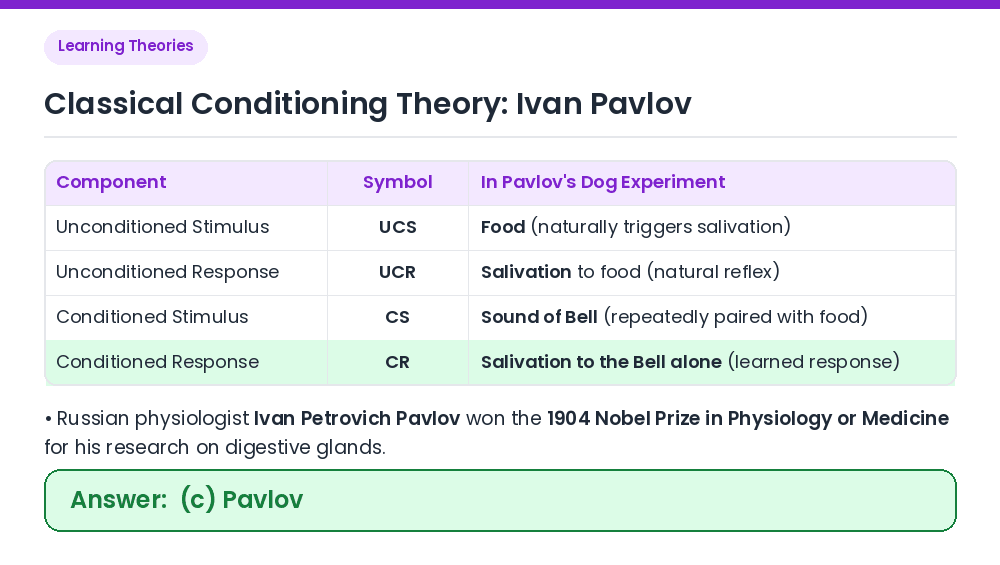
Answer: (C) Pavlov
Russian physiologist Ivan Petrovich Pavlov (1849–1936) proposed the theory of Classical Conditioning (प्राचीन / शास्त्रीय अनुबंधन का सिद्धांत), also known as Respondent Conditioning or Conditioned Reflex theory. • While studying the digestive glands and salivation reflex of dogs, Pavlov discovered that a neutral stimulus (the sound of a bell / metronome, CS) when repeatedly paired with an unconditioned stimulus (food, UCS) eventually elicits salivation (CR) on its own. • Pavlov was awarded the Nobel Prize in Physiology or Medicine in 1904 for his work on the physiology of digestion. Why other options are wrong: • (a) Skinner: Proposed Operant / Instrumental Conditioning (क्रिया-प्रसूत अनुबंधन) based on reinforcement. • (b) Spinovich: Distractor name, not a learning theorist. • (d) Alfred Binet: French psychologist who developed the first practical Intelligence Test (Binet–Simon Scale, 1905) and introduced the concept of Mental Age (1908). Related Facts: • Key phenomena in Classical Conditioning: Extinction (विलोपन), Spontaneous Recovery (स्वतः पुनर्लाभ), Stimulus Generalization (उद्दीपन सामान्यीकरण), and Stimulus Discrimination (उद्दीपन विभेदन). • J. B. Watson and Rosalie Rayner applied Pavlov's classical conditioning to human emotions in the famous 'Little Albert' experiment (1920). Correct Answer: (c) Pavlov