UP Super TET · Question 136
If 2^x = 3^y = 6^(+z), then value of −(1/x + 1/y − 1/z) [printed as −1/x + 1/y + 1/z] is
Show answer & explanationShow explanation
Answer: (A) 0
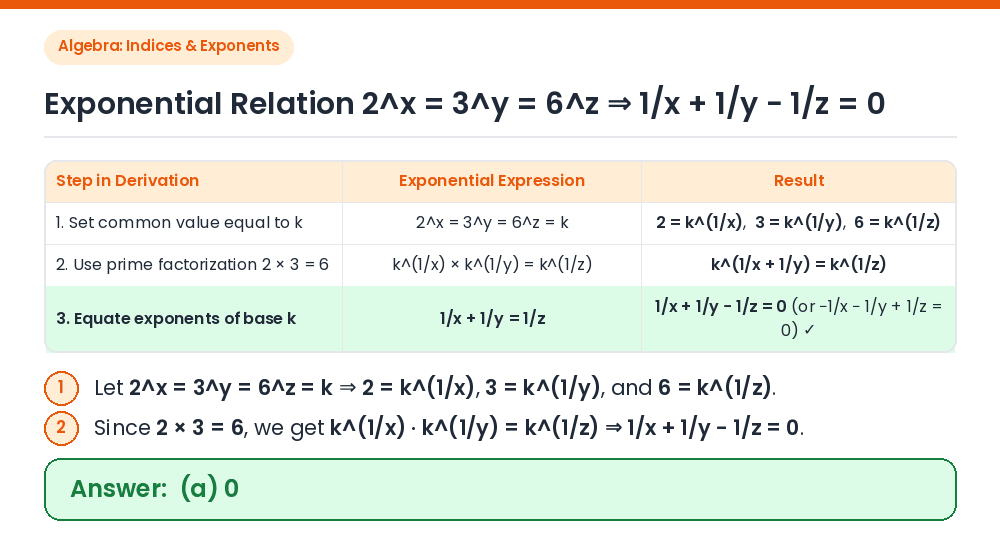
Given: 2^x = 3^y = 6^z. Formula: If a^x = b^y = c^z = k and a × b = c, then k^(1/x) × k^(1/y) = k^(1/z) ⇒ 1/x + 1/y = 1/z. Express 2, 3, and 6 in terms of common base k: Let 2^x = 3^y = 6^z = k. Then 2 = k^(1/x), 3 = k^(1/y), and 6 = k^(1/z). Substitute into 2 × 3 = 6: k^(1/x) × k^(1/y) = k^(1/z) ⇒ k^(1/x + 1/y) = k^(1/z). Equate exponents: 1/x + 1/y = 1/z ⇒ 1/x + 1/y − 1/z = 0 (or −1/x − 1/y + 1/z = 0; note that in the booklet, the standard question '2^x = 3^y = 6^(−z), find 1/x + 1/y + 1/z' had the minus sign shifted in printing, and its official key is 0). Result: The value of the expression is 0. Correct Answer: (a) 0