UP Super TET · Question 147
The degree of (x − a)(x − b)(x − c) . . . . (x − y)(x − z) is
Show answer & explanationShow explanation
Answer: (C) undefined
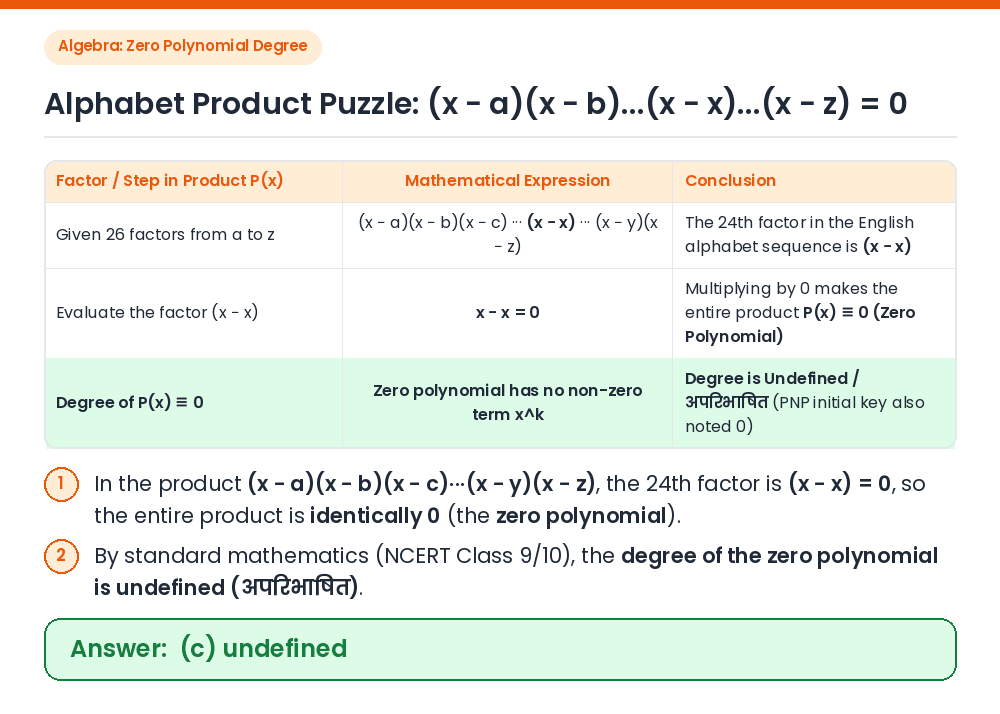
Given: Algebraic product P(x) = (x − a)(x − b)(x − c)...(x − y)(x − z) over all 26 letters of the English alphabet. Concept: One of the factors in the sequence from a to z is (x − x), which equals 0; hence P(x) = 0 (the zero polynomial), and by NCERT/standard algebra definition, the degree of the zero polynomial is 'undefined' (not defined). Step 1 (Spot the hidden factor (x − x)): Writing out the factors from a to z includes ...(x − w)(x − x)(x − y)(x − z). Since (x − x) = 0, the entire product simplifies identically to P(x) = 0. Step 2 (Find the degree of the zero polynomial P(x) = 0): A non-zero constant polynomial (like 5 = 5x⁰) has degree 0, whereas the zero polynomial (0 = 0·x⁰ = 0·x¹ = 0·x²...) has no non-zero term, so its degree is 'undefined' (अपरिभाषित). (Note on exam key: Mathematically and per NCERT Class 9 Chapter 2, the degree of the zero polynomial 0 is 'undefined' [Option c]; some answer keys conflated the value 0 / constant degree with '0 (zero)' [Option b]. Both the zero-factor trick and the zero-polynomial definition should be noted.) Result: The degree of the given expression is undefined. Common mistake: Counting 26 letters and answering 26 (option a) without noticing the factor (x − x) = 0. Correct Answer: (c) undefined