UP Super TET · Question 4
Brahmi script was deciphered by
Show answer & explanationShow explanation
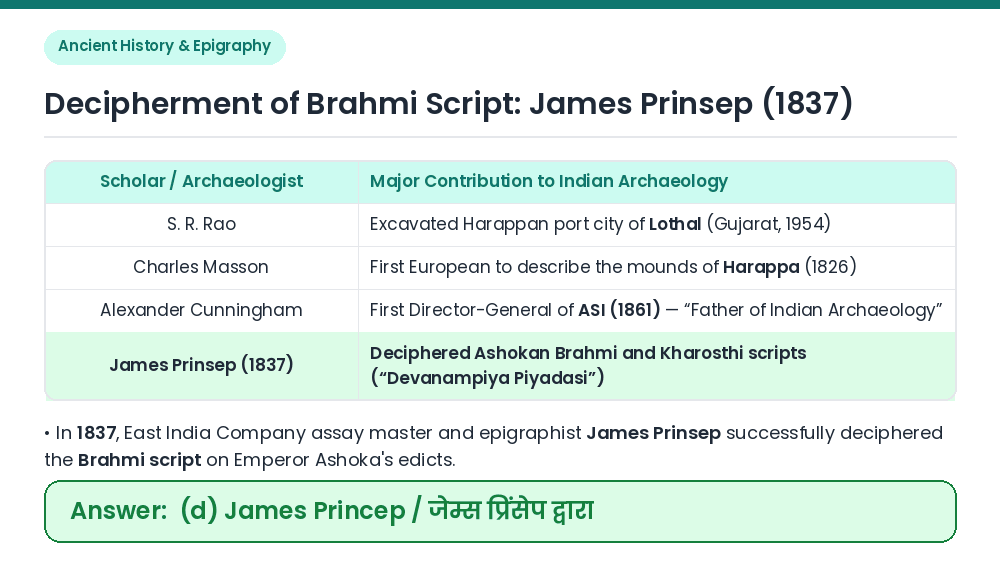
Answer: (D) James Princep
The ancient Brahmi script (as well as the Kharosthi script) was deciphered in 1837 by British orientalist, antiquary, and Calcutta Mint assay master James Prinsep. By studying short votive inscriptions from the Sanchi Stupa ending with the word 'danam' (gift) and bilingual Indo-Greek coins, Prinsep unlocked the Brahmi alphabet and read Emperor Ashoka's pillar and rock edicts inscribed in the name of 'Devanampiya Piyadasi'. Why other options are wrong: • (a) S. R. Rao: Indian archaeologist who excavated the Indus Valley dockyard site of Lothal. • (b) Charles Masson: British soldier-explorer who first documented the ruins of Harappa in 1826. • (c) Alexander Cunningham: Founded the Archaeological Survey of India (ASI) in 1861 and is known as the 'Father of Indian Archaeology'. Related Facts: • Padre Tieffenthaler was the first European to discover an Ashokan pillar (Delhi–Meerut pillar) in 1750, but its Brahmi script remained unread until James Prinsep deciphered it in 1837. • Most of Ashoka's inscriptions in the Indian subcontinent are written in Prakrit language and Brahmi script (written left to right), while those at Shahbazgarhi and Mansehra (in Pakistan) are in Kharosthi script (written right to left). • The Maski inscription (discovered in 1915 by C. Beadon in Raichur, Karnataka) was the first edict to explicitly mention Ashoka's personal name. Correct Answer: (d) James Princep