UP Super TET · Question 43
Which of the following was not the main feature of the Government of India Act, 1919?
Show answer & explanationShow explanation
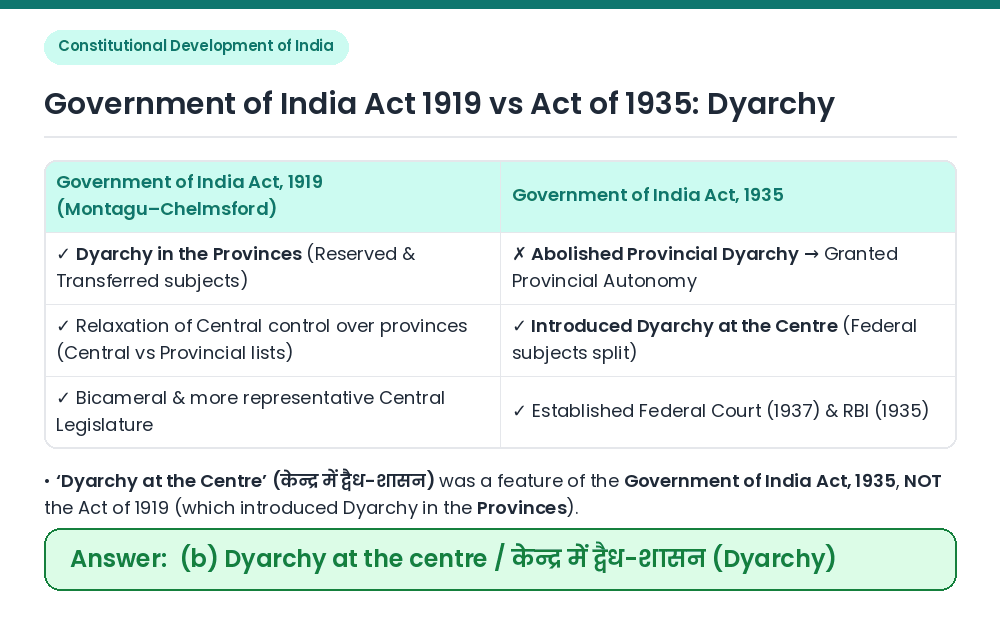
Answer: (B) Dyarchy at the centre
'Dyarchy at the centre' (केन्द्र में द्वैध-शासन) was NOT a feature of the Government of India Act, 1919—it was introduced later by the Government of India Act, 1935. Feature-by-feature verification of the Government of India Act, 1919 (Montagu–Chelmsford Reforms): • (a) Dyarchy in the provinces (True feature of 1919 Act): Provincial subjects were divided into 'Transferred' (हस्तांतरित — administered by Governor with Indian Ministers responsible to the Legislative Council) and 'Reserved' (आरक्षित — administered by Governor with his Executive Council). • (b) Dyarchy at the centre (NOT a feature of 1919 Act — Correct Answer): The 1935 Act abolished Dyarchy in the provinces (introducing Provincial Autonomy) and instead introduced Dyarchy at the Centre. • (c) Relaxation of Central control over provinces (True feature of 1919 Act): Achieved by demarcating and separating Central and Provincial subjects and budgets. • (d) Indian Legislature made more representative (True feature of 1919 Act): Introduced a bicameral legislature at the Centre (Council of State and Legislative Assembly) with a majority of directly elected members. Related Facts: • The father of the concept of 'Dyarchy' (द्वैध-शासन) was Sir Lionel Curtis. • The Government of India Act, 1919 also provided for the establishment of a Public Service Commission in India (set up in 1926 on the recommendation of the Lee Commission). Correct Answer: (b) Dyarchy at the centre