UP Super TET · Question 55
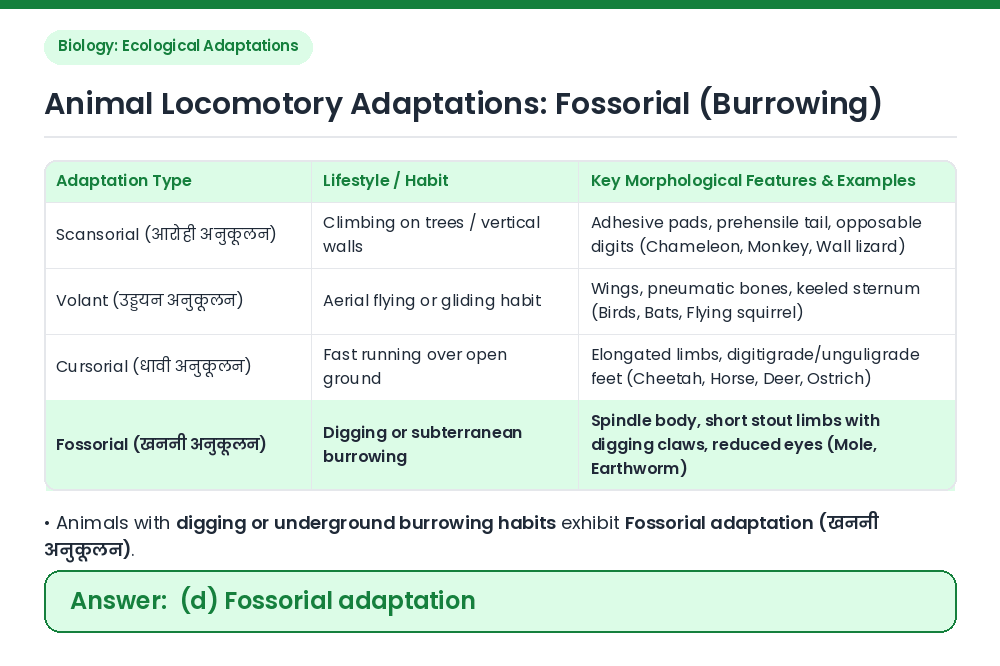
The animals with digging or burrowing habits shows the following type of adaptations
Show answer & explanationShow explanation
Answer: (D) Fossorial adaptation
Animals with digging or underground burrowing habits exhibit Fossorial adaptation (from Latin 'fossor', meaning digger). Fossorial animals (such as moles, mole-rats, burrowing snakes like Uropeltis, rabbits, and earthworms) have a compact spindle-shaped body, conical snout, short powerful forelimbs equipped with broad spade-like claws for digging, and reduced or vestigial eyes and external ears. Why other options are wrong: • (a) Scansorial adaptation: Adaptation for climbing trees, rocks, or vertical walls (e.g., squirrels, monkeys, chameleons, geckos). • (b) Volant adaptation: Adaptation for aerial flight or gliding (e.g., birds, bats, Draco flying lizard). • (c) Cursorial adaptation: Adaptation for fast running on open ground (e.g., cheetah, horse, deer, ostrich). Related Facts: • Arboreal animals live primarily on trees, amphibious animals live both on land and in water, and pelagic/natatorial animals are adapted for swimming in open water. • In moles (Talpa), the humerus bone is extraordinarily broad and the forepaws are turned outward like shovels. Correct Answer: (d) Fossorial adaptation