UP Super TET · Question 91
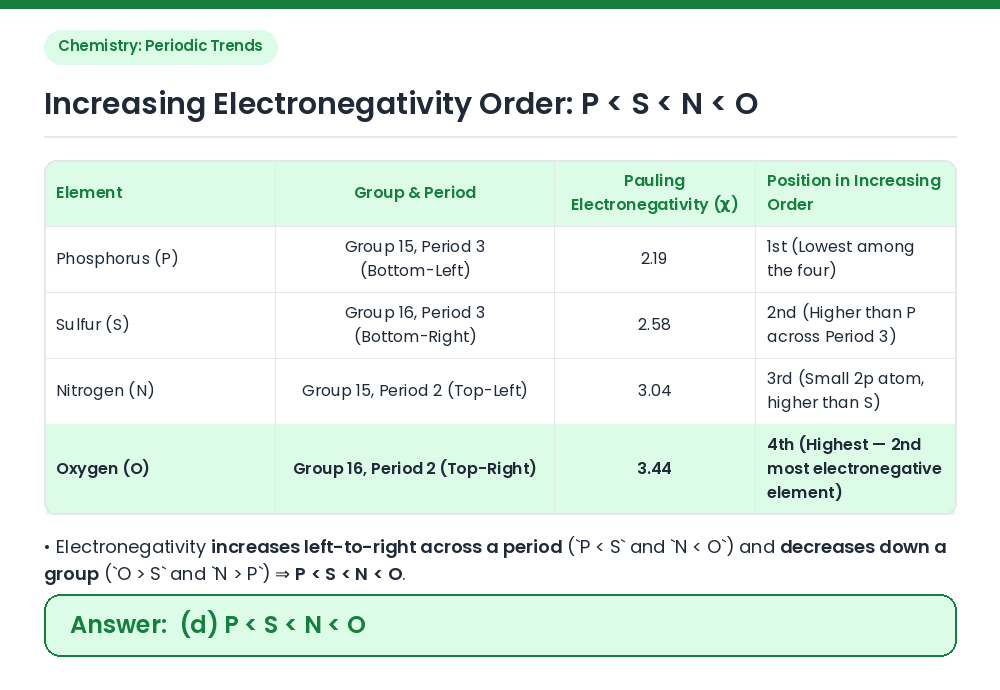
The electronegativity of N, O, P and S increases in the order
Show answer & explanationShow explanation
Answer: (D) P < S < N < O
The electronegativity of N, O, P, and S increases in the order P < S < N < O. In the periodic table, electronegativity increases from left to right across a period (so P < S in Period 3, and N < O in Period 2) and decreases from top to bottom down a group (so Period-3 elements P and S have lower electronegativity than Period-2 elements N and O). On the Pauling scale, their exact values are P (2.19) < S (2.58) < N (3.04) < O (3.44). Why other options are wrong: • (a) N < O < P < S: Incorrectly places Period-3 elements P and S above Period-2 elements N and O. • (b) P < N < O < S: Incorrectly places S (2.58) higher than N (3.04) and O (3.44). • (c) S < P < N < O: Incorrectly places S (2.58) below P (2.19). Related Facts: • Across the entire periodic table, the four most electronegative elements in decreasing order are Fluorine (F = 4.0) > Oxygen (O = 3.44) > Nitrogen (N = 3.04) ≈ Chlorine (Cl = 3.16) (mnemonic: FON). • Chlorine has the highest negative electron gain enthalpy (electron affinity), whereas Fluorine has the highest electronegativity. Correct Answer: (d) P < S < N < O