UP Super TET · Question 72
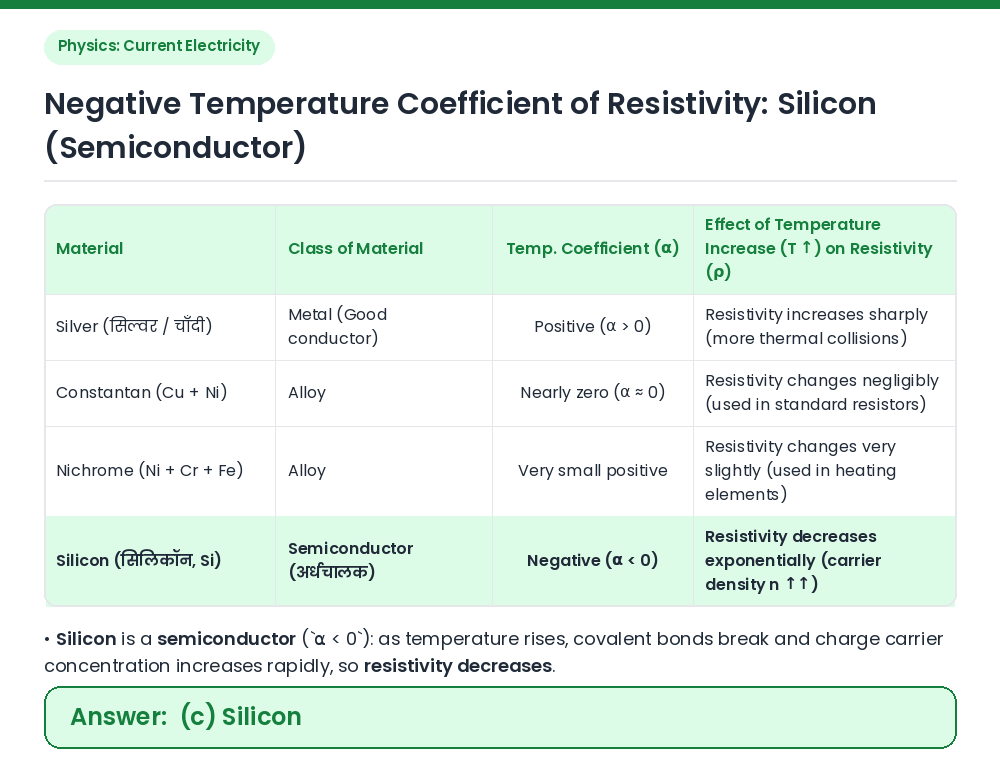
The resistivity of a material is found to decrease with an increase in temperature. The material is
Show answer & explanationShow explanation
Answer: (C) Silicon
The material whose resistivity decreases with an increase in temperature is Silicon (a semiconductor). In semiconductors like Silicon (Si) and Germanium (Ge), an increase in temperature breaks covalent bonds and exponentially increases the number density (n) of charge carriers (free electrons and holes); since ρ = m / (n e² τ), the rapid rise in n outweighs the decrease in relaxation time τ, so resistivity decreases with rising temperature (negative temperature coefficient of resistivity, α < 0). Why other options are wrong: • (a) Constantan: An alloy of Copper (55%) and Nickel (45%) with a negligible positive α; used for making standard resistance coils. • (b) Silver: A metallic conductor (highest electrical conductivity) whose resistivity increases linearly with temperature (α > 0). • (d) Nichrome: An alloy of Nickel, Chromium, and Iron with high resistivity and small positive α; used in electric heating elements. Related Facts: • At absolute zero (0 K), an intrinsic semiconductor like pure Silicon behaves as a perfect insulator. • Carbon (graphite), Germanium, Silicon, and electrolytes all have a negative temperature coefficient of resistance (α < 0). Correct Answer: (c) Silicon