RRB NTPC · Question 56
In this question, a question is followed by two statements numbered (I) and (II). You have to decide whether the data provided in the statements are sufficient to answer the question. Read both the statements and decide the appropriate answer. Q. Five people – Pallavi, Shreya, Monika, Ritu, and Alka – are sitting in a straight line facing north. Who is sitting at the extreme left end? (I) Shreya sits immediately to the right of Pallavi. (II) Monika sits immediately to the right of Shreya, and Ritu is not at any end.
Show answer & explanationShow explanation
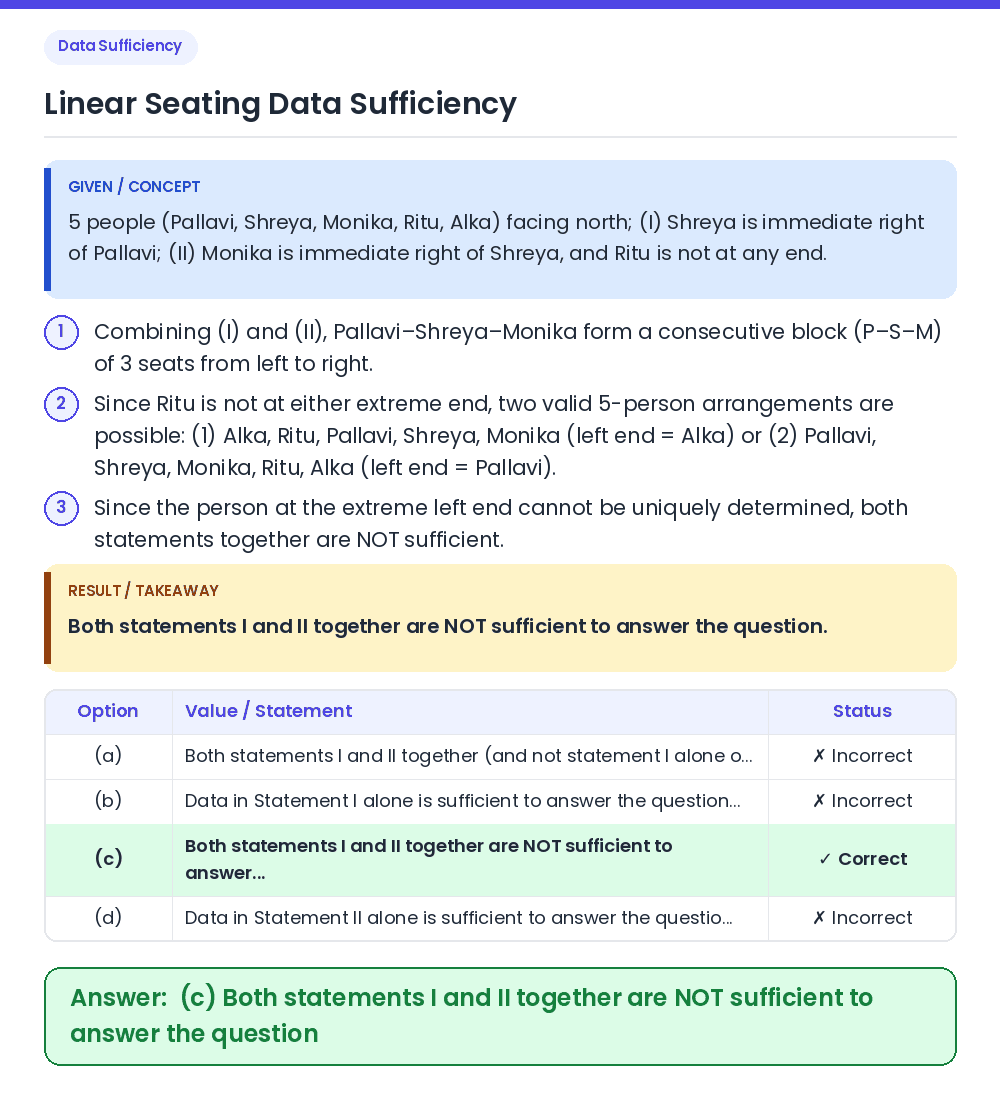
Answer: (C) Both statements I and II together are NOT sufficient to answer the question
GIVEN / CONCEPT: 5 people (Pallavi, Shreya, Monika, Ritu, Alka) facing north; (I) Shreya is immediate right of Pallavi; (II) Monika is immediate right of Shreya, and Ritu is not at any end. Relation / Equation: Combining (I) and (II), Pallavi–Shreya–Monika form a consecutive block (P–S–M) of 3 seats from left to right. Simplification / Calculation: Since Ritu is not at either extreme end, two valid 5-person arrangements are possible: (1) Alka, Ritu, Pallavi, Shreya, Monika (left end = Alka) or (2) Pallavi, Shreya, Monika, Ritu, Alka (left end = Pallavi). Verification / Deduction: Since the person at the extreme left end cannot be uniquely determined, both statements together are NOT sufficient. RESULT / TAKEAWAY: Both statements I and II together are NOT sufficient to answer the question. Correct Answer: (c) Both statements I and II together are NOT sufficient to answer the question