RRB NTPC · Question 85
According to Joule’s law of heating, the heat produced in a resistor is _____________________.
Show answer & explanationShow explanation
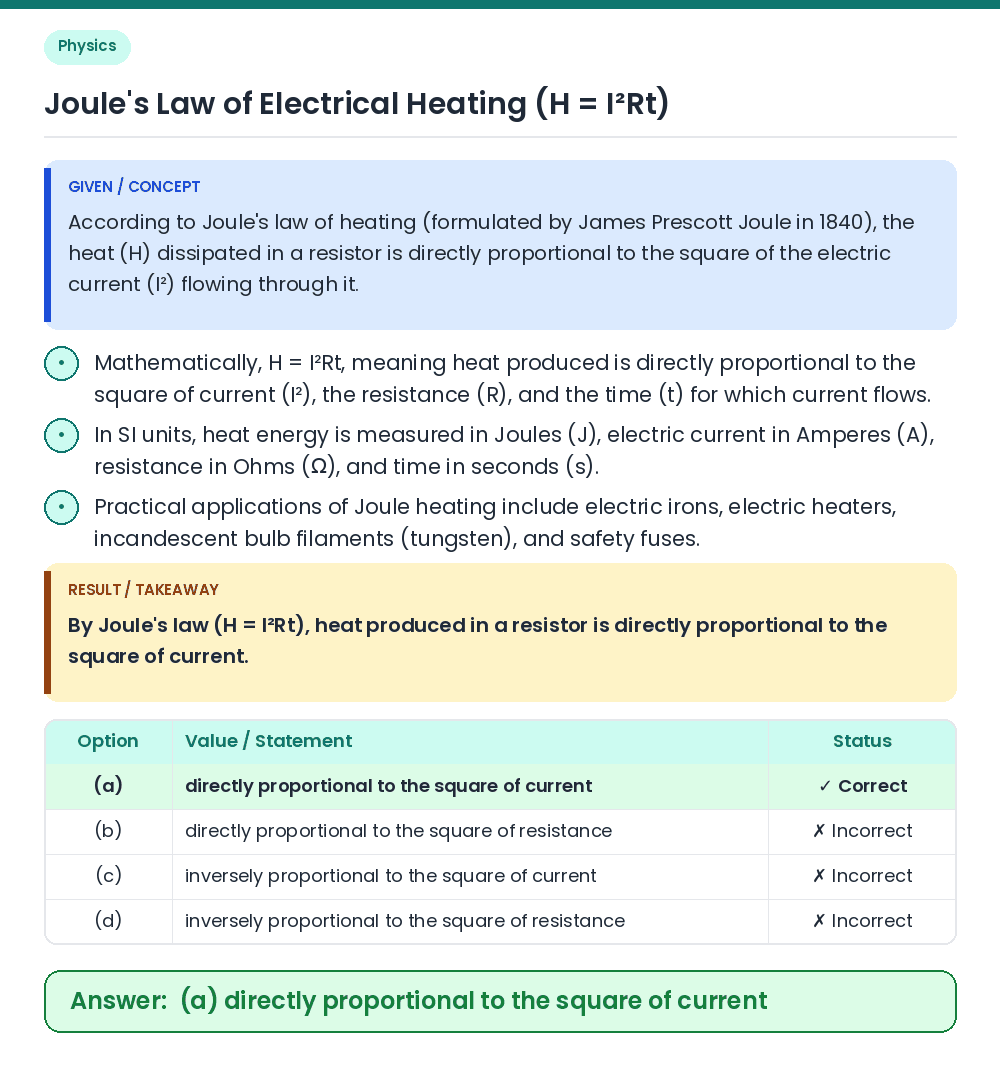
Answer: (A) directly proportional to the square of current
• According to Joule's law of heating (formulated by James Prescott Joule in 1840), the heat (H) dissipated in a resistor is directly proportional to the square of the electric current (I²) flowing through it. • By Joule's law (H = I²Rt), heat produced in a resistor is directly proportional to the square of current. Related Facts: • Mathematically, H = I²Rt, meaning heat produced is directly proportional to the square of current (I²), the resistance (R), and the time (t) for which current flows. • In SI units, heat energy is measured in Joules (J), electric current in Amperes (A), resistance in Ohms (Ω), and time in seconds (s). • Practical applications of Joule heating include electric irons, electric heaters, incandescent bulb filaments (tungsten), and safety fuses. Correct Answer: (a) directly proportional to the square of current