MPPSC – State Service Examination · Question 96
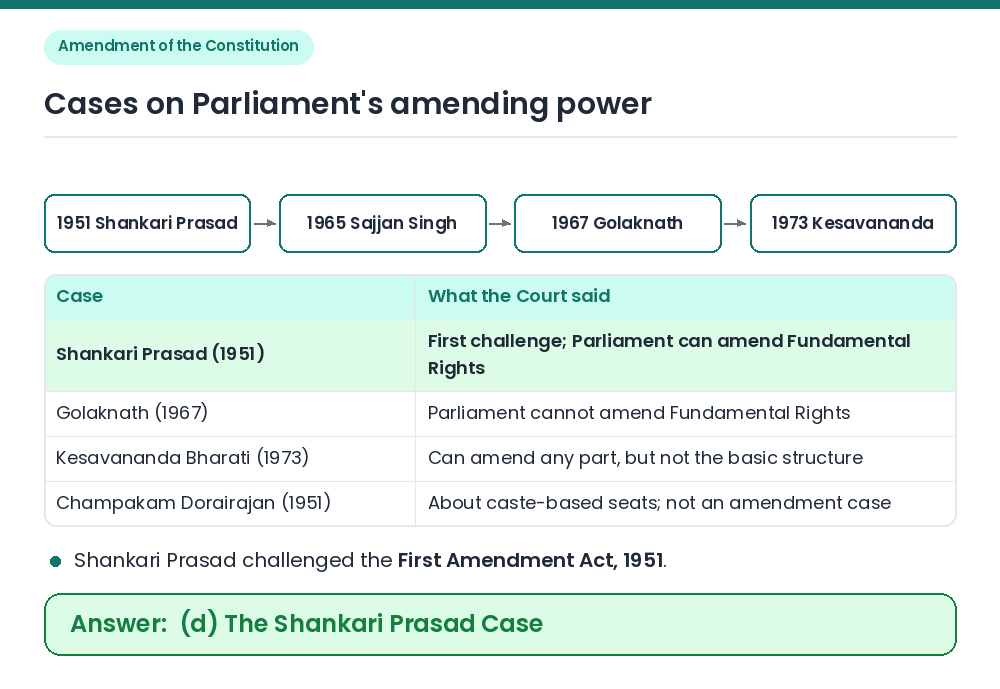
The Parliament's power to amend the Constitution received first challenge through which of the following cases?
Show answer & explanationShow explanation
Answer: (D) The Shankari Prasad Case
The first challenge to Parliament's power to amend the Constitution came in Shankari Prasad v. Union of India (1951). The case questioned the First Amendment Act, 1951, which had cut down the right to property and added the Ninth Schedule. The Supreme Court held that the power to amend under Article 368 includes the power to amend Fundamental Rights. It said that the word 'law' in Article 13 means ordinary laws, not constitutional amendments. (a) Kesavananda Bharati (1973) came much later and gave the 'basic structure' doctrine: Parliament can amend any part but cannot destroy the basic features. (b) Golaknath (1967) reversed the earlier view and held that Parliament cannot amend Fundamental Rights. (c) Champakam Dorairajan (1951) was about caste-based reservation of college seats in Madras; it was a cause of the First Amendment, not a challenge to the amending power. Related Facts: • Sajjan Singh v. State of Rajasthan (1965) followed the Shankari Prasad view. • The 24th Amendment Act, 1971 was passed to cancel the effect of the Golaknath judgment. • Minerva Mills (1980) held that the limited amending power is itself part of the basic structure. Correct Answer: (d) The Shankari Prasad Case