MPPSC – State Service Examination · Question 98
In the execution of which of the following functions, Lok Sabha and Rajya Sabha have equal powers?
Show answer & explanationShow explanation
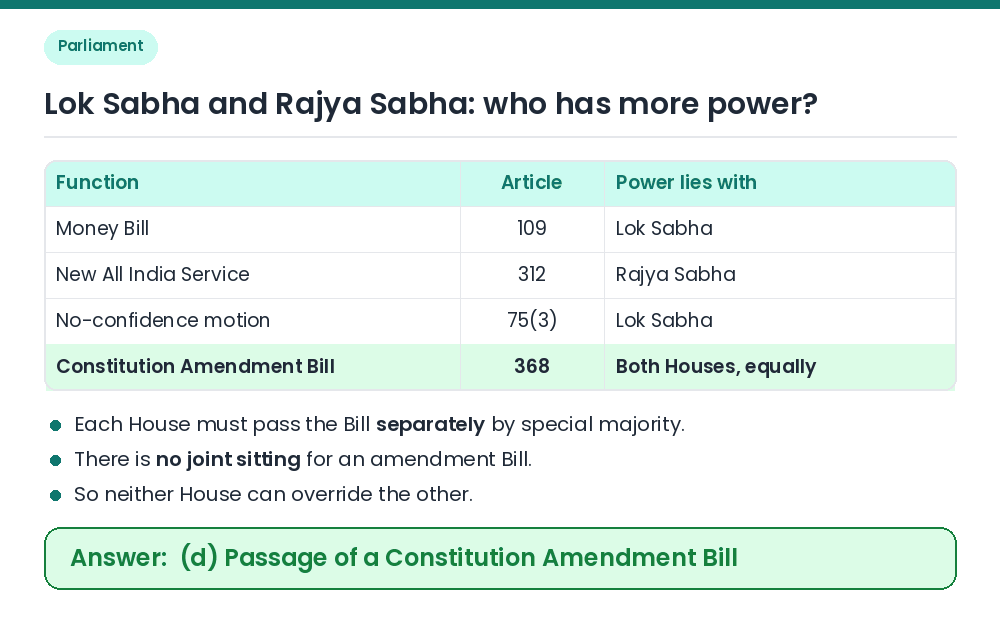
Answer: (D) Passage of a Constitution Amendment Bill
The two Houses have equal powers in passing a Constitution Amendment Bill. Under Article 368, such a Bill must be passed by each House separately by a special majority. A special majority means a majority of the total membership of the House and two-thirds of the members present and voting. There is no joint sitting if the Houses disagree, so the Rajya Sabha can block the Bill just as the Lok Sabha can. (a) A Money Bill can be introduced only in the Lok Sabha; the Rajya Sabha can only suggest changes and must return it within 14 days (Article 109). (b) A new All India Service can be created only after the Rajya Sabha passes a resolution by two-thirds of members present and voting (Article 312); this is a special power of the Rajya Sabha. (c) A no-confidence motion can be moved only in the Lok Sabha, because the Council of Ministers is responsible to the Lok Sabha alone (Article 75(3)). Related Facts: • The Houses also have equal powers in electing and impeaching the President and in approving emergency proclamations. • A joint sitting (Article 108) is possible only for ordinary Bills, not for Money Bills or Constitution Amendment Bills. • Under Article 249 the Rajya Sabha alone can allow Parliament to make a law on a State List subject. Correct Answer: (d) Passage of a Constitution Amendment Bill