Civil Services Examination · Question 115
When an air bubble at the bottom of a lake rises to the top, it will
Show answer & explanationShow explanation
Answer: (A) increase in size
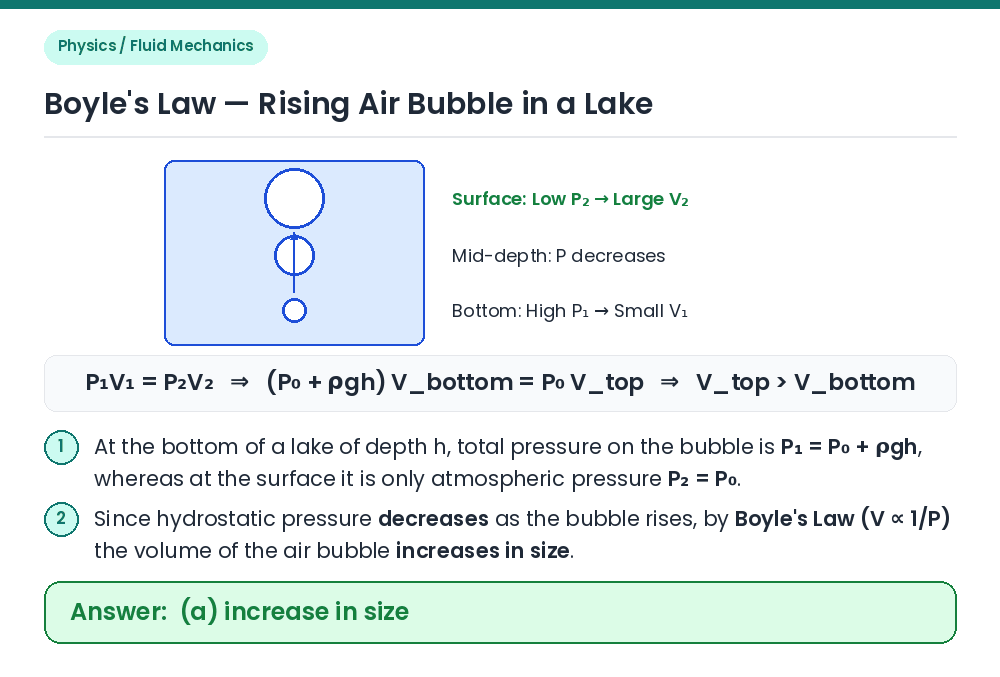
Concept: Apply hydrostatic pressure (P = P₀ + ρgh) and Boyle's Law (PV = constant at approximately constant temperature) to a rising gas bubble. Pressure Change with Depth: ⇒ At the bottom of a lake at depth h, the air bubble experiences high pressure equal to atmospheric pressure plus the weight of the water column (P₁ = P₀ + ρgh). As the bubble rises toward the surface (h → 0), the surrounding water pressure decreases steadily to P₂ = P₀. Volume Change by Boyle's Law: ⇒ Since P₁V₁ = P₂V₂ and P₂ < P₁, it follows that V₂ > V₁ — the bubble expands as external pressure drops. Result: When an air bubble rises from the bottom of a lake to the top, it will increase in size. Related Facts: • Numerical Benchmark: Since 1 atmospheric pressure (~10⁵ Pa) equals roughly 10.3 metres of water depth, a bubble whose radius doubles (volume becomes 8 times: V₂ = 8V₁) rises from a depth of h = 7 × 10.3 ≈ 72 metres. Correct Answer: (a) increase in size