Civil Services Examination · Question 116
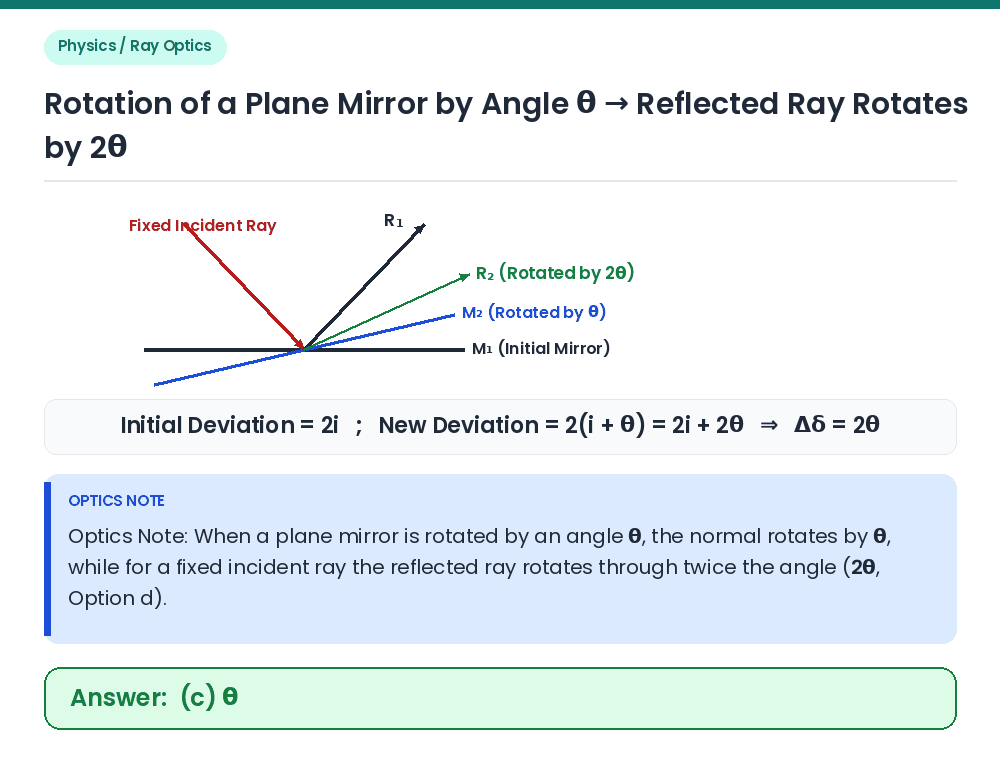
When a mirror is rotated by an angle of θ, the reflected ray will rotate by
Show answer & explanationShow explanation
Answer: (C) θ
Concept: Apply the Law of Reflection (angle of incidence i = angle of reflection r) to find the angle through which the reflected ray turns when a plane mirror is rotated by an angle θ (keeping the incident ray fixed). Derivation: ⇒ Initially, the angle between the incident ray and the reflected ray is 2i. When the plane mirror is rotated by an angle θ, the normal to the mirror also rotates by θ, changing the angle of incidence to (i + θ). By the law of reflection, the new angle of reflection also becomes (i + θ), so the new angle between the incident and reflected rays is 2(i + θ) = 2i + 2θ. Angle of Rotation: ⇒ While the normal to the mirror rotates by an angle θ [option (c)], for a fixed incident ray the reflected ray rotates through an angle of (2i + 2θ) − 2i = 2θ [option (d)]. Result: When a plane mirror is rotated by an angle θ, the normal rotates by θ and the reflected ray rotates by 2θ. Related Facts: • Optical Lever Application: Mirror galvanometers and sextants use this 2θ doubling principle to measure very small angular deflections with high sensitivity. Correct Answer: (c) θ