Civil Services Examination · Question 34
One of the important goals of the economic liberalisation policy is to achieve full convertibility of the Indian rupee. This is being advocated because
Show answer & explanationShow explanation
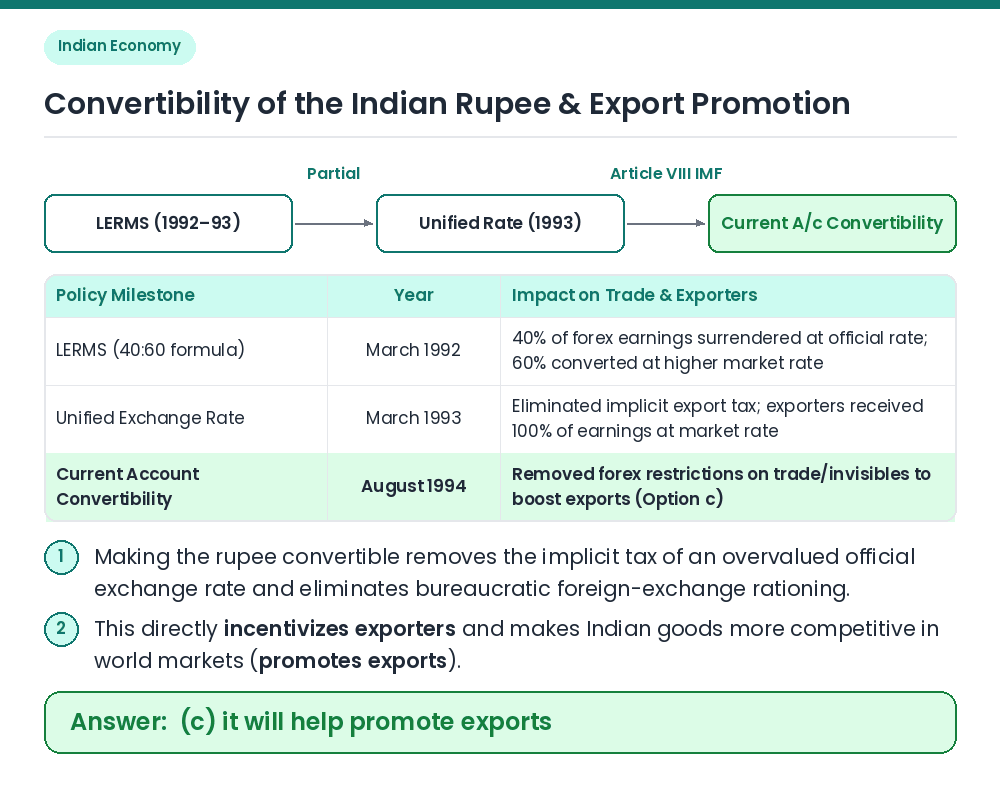
Answer: (C) it will help promote exports
Concept: Understand why exchange-rate liberalisation and rupee convertibility were central to India's trade policy reforms in the early 1990s. Mechanism: ⇒ Under the pre-1991 fixed/overvalued exchange rate regime, exporters had to surrender foreign exchange earnings to the RBI at an artificially low official rate, which acted as an implicit tax on exports. Impact of Convertibility: ⇒ Moving through LERMS (1992) to a unified market-determined exchange rate (1993) and full Current Account Convertibility (August 1994) allowed exporters to convert their foreign earnings freely at market rates and import necessary inputs easily, thereby directly promoting exports. Result: Full convertibility of the rupee is advocated because it helps promote exports. Related Facts: • IMF Article VIII Status: India accepted the obligations of Article VIII of the IMF Articles of Agreement on 20 August 1994, making the rupee fully convertible on the current account. • Tarapore Committees (1997 & 2006): Appointed by the RBI to lay down the roadmap and preconditions for Capital Account Convertibility. Correct Answer: (c) it will help promote exports