Civil Services Examination · Question 82
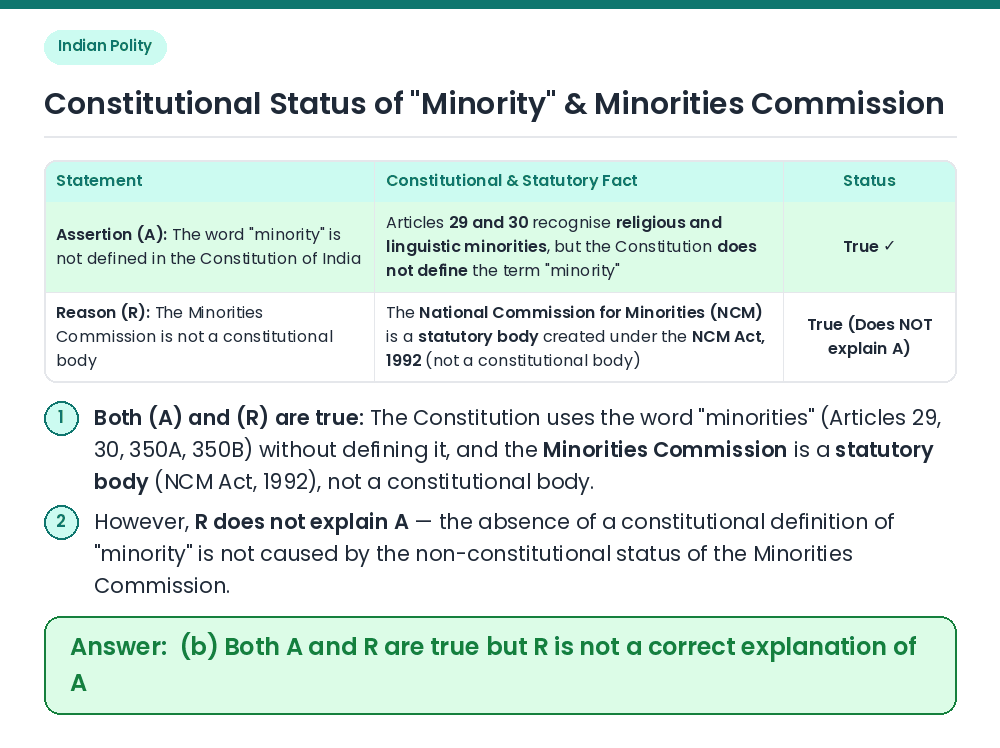
Assertion (A): The word 'minority' is not defined in the Constitution of India. Reason (R): The Minorities Commission is not a constitutional body. In the context of the above two statements, which one of the following is correct?
Show answer & explanationShow explanation
Answer: (B) Both A and R are true but R is not a correct explanation of A
Concept: Verify the constitutional treatment of the term 'minority' and the legal status of the National Commission for Minorities. Evaluate Assertion A: ⇒ Although Articles 29 and 30 (Cultural and Educational Rights) and Article 350B refer to 'minorities' (specifically religious and linguistic minorities), the Constitution of India nowhere defines the word 'minority' — so A is true. Evaluate Reason R & Causal Link: ⇒ The Minorities Commission (initially set up by an executive resolution in 1978 and later given statutory status under the National Commission for Minorities Act, 1992) is a statutory body and not a constitutional body — so R is also true. However, the statutory nature of the Commission is not the reason why the Constitution did not define the word 'minority'. Result: Both A and R are true, but R is not a correct explanation of A. Related Facts: • T.M.A. Pai Foundation v. State of Karnataka (2002): The Supreme Court ruled that since states were reorganised on linguistic lines, the unit for determining the status of both linguistic and religious minorities under Article 30 is the State, not the whole of India. • Six Notified Religious Minorities (under NCM Act, 1992): Muslims, Christians, Sikhs, Buddhists, Zoroastrians (Parsis), and Jains (added in 2014). Correct Answer: (b) Both A and R are true but R is not a correct explanation of A