Civil Services Examination · Question 86
In medieval India, Mansabdari system was introduced mainly for
Show answer & explanationShow explanation
Answer: (A) making recruitment to the army
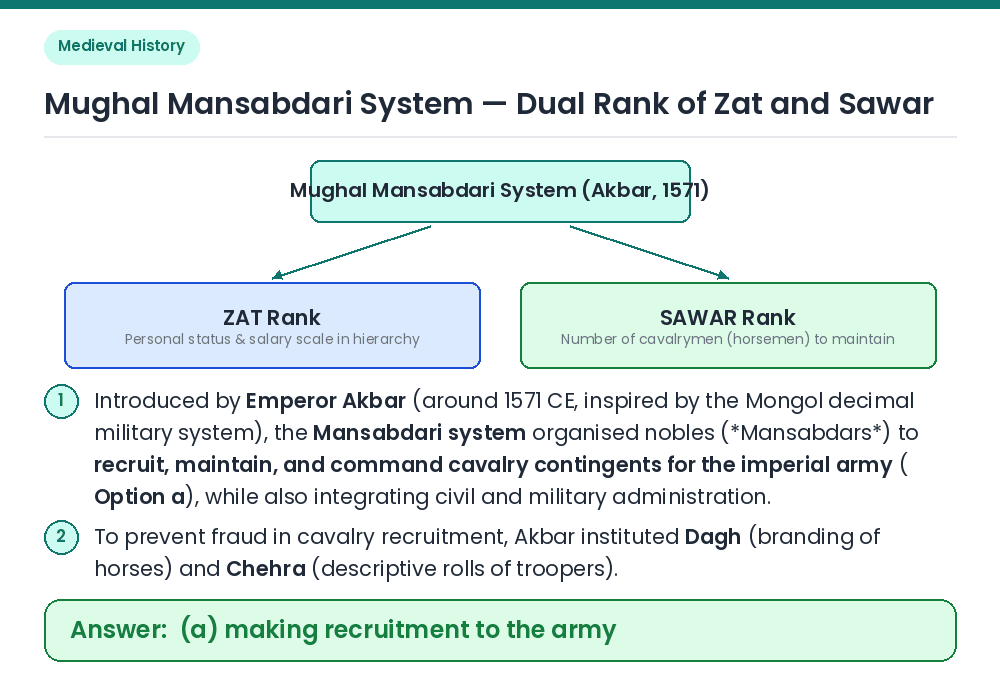
Concept: Understand the primary military-administrative purpose for which Emperor Akbar introduced the Mansabdari system in the Mughal Empire. Military Recruitment Mechanism: ⇒ Because the Mughal state did not maintain a massive centrally recruited standing army, it relied on Mansabdars (holders of rank or 'mansab', graded on a decimal scale from 10 to 10,000) to recruit, equip, and maintain specified quotas of cavalrymen (Sawar) for imperial military service, while also integrating the nobility into a unified civil-military hierarchy. Inspection & Control: ⇒ Through the Dag-o-Mahalli department (branding of horses and descriptive rolls of soldiers), Mansabdars presented their recruited contingents for regular inspection before receiving Jagir or Naqdi (cash) pay. Result: The Mansabdari system was introduced mainly for making recruitment to the army. Related Facts: • Du-Aspa Sih-Aspa: Introduced by Emperor Jahangir, allowing selected Mansabdars to maintain double or triple the number of troopers without raising their Zat rank. • Month-Scale (Mahwar): Introduced by Emperor Shah Jahan to scale down cavalry obligations when the actual revenue yield (Hasil) of a Jagir fell short of its assessed value (Jama). Correct Answer: (a) making recruitment to the army