Civil Services Examination · Question 55
If the Prime Minister of India belonged to the Upper House of Parliament
Show answer & explanationShow explanation
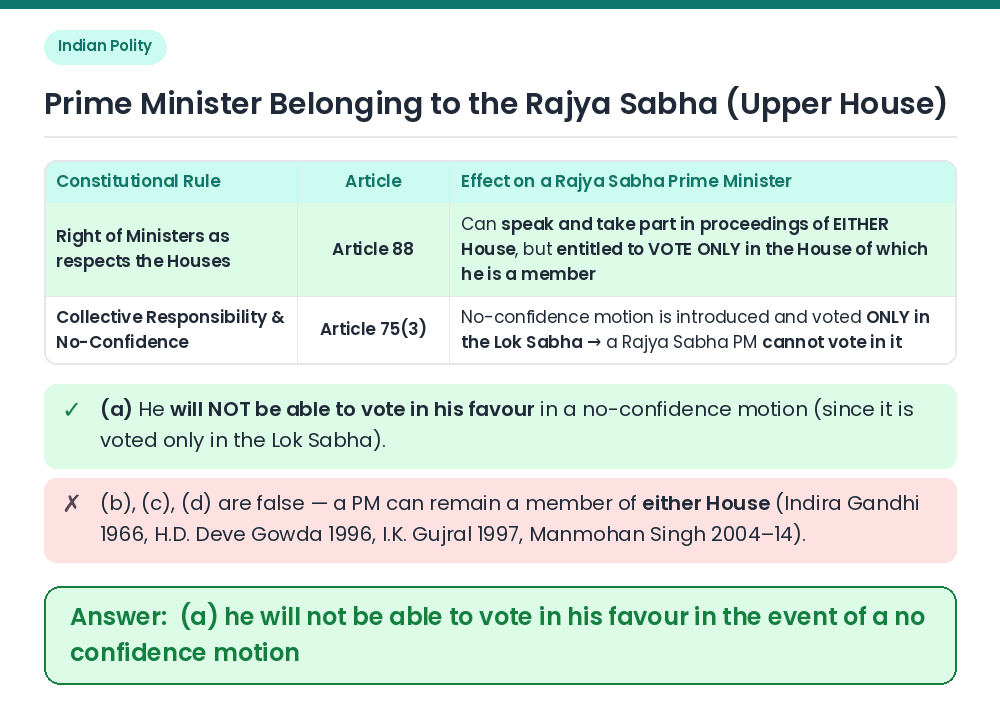
Answer: (A) he will not be able to vote in his favour in the event of a no confidence motion
Concept: Under the Indian Constitution, the Prime Minister may be a member of either House of Parliament — the Lok Sabha (Lower House) or the Rajya Sabha (Upper House). Applying Articles 75 and 88: • Under Article 88, every Minister has the right to speak and participate in the proceedings of both Houses, but can vote ONLY in the House of which he is a member. • Since a no-confidence motion can be moved and voted upon only in the Lok Sabha (Article 75(3)), a Prime Minister who is a member of the Rajya Sabha cannot vote in a no-confidence motion. Result: Option (a) is correct. Related Facts: • Prime Ministers from the Rajya Sabha: Indira Gandhi (1966), H.D. Deve Gowda (1996–97), I.K. Gujral (1997–98), and Dr. Manmohan Singh (2004–2014). • British Comparison: In the UK, by constitutional convention, the Prime Minister must belong to the House of Commons (Lower House). Correct Answer: (a) he will not be able to vote in his favour in the event of a no confidence motion