Civil Services Examination · Question 29
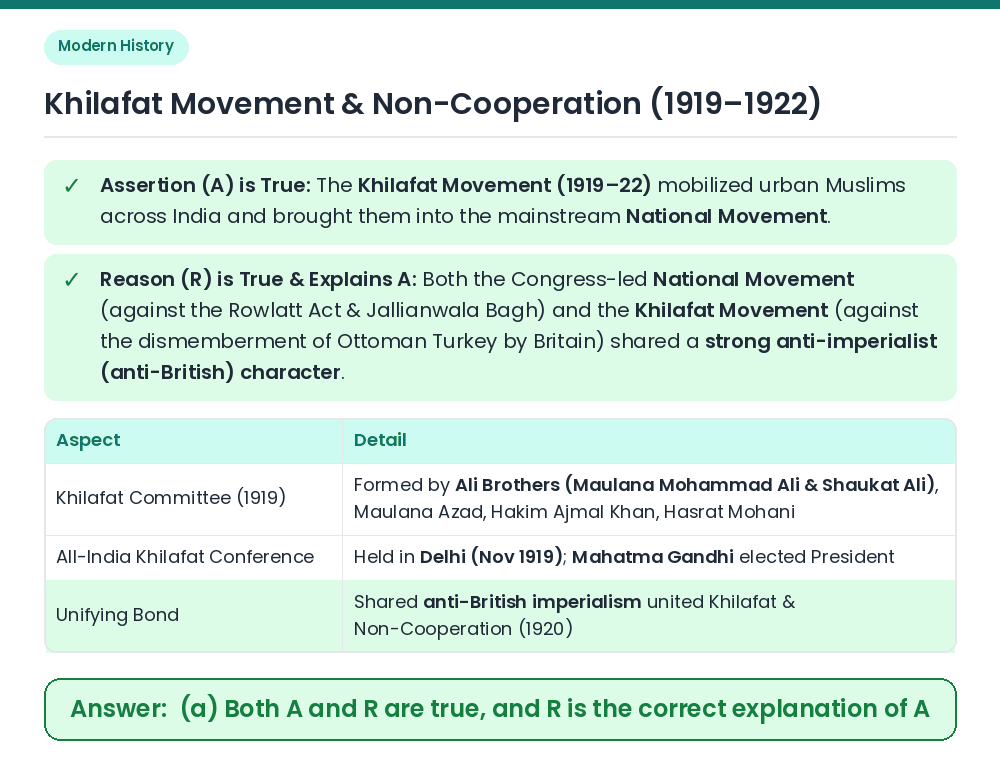
Assertion (A): The Khilafat movement did bring the urban Muslims into the fold of the National Movement. Reason (R): There was a predominant element of anti-imperialism in both the National and Khilafat Movements.
Show answer & explanationShow explanation
Answer: (A) Both A and R are true, and R is the correct explanation of A
Given / Concept: The Khilafat Movement (1919–1924) protested against the harsh treatment meted out to the Ottoman Empire (and the Caliph) by Britain after World War I (Treaty of Sèvres). Evaluate Assertion A: Led by the Ali Brothers and Maulana Abul Kalam Azad in alliance with Mahatma Gandhi's Non-Cooperation Movement, the Khilafat agitation brought large numbers of urban Muslims into the Indian National Movement ⇒ A is true. Evaluate Reason R & Link: Because both movements targeted British imperialism as the common adversary, this shared anti-imperialist element enabled their convergence into a unified mass struggle ⇒ R is true and explains A. Result: Both A and R are true, and R is the correct explanation of A. Related Facts: • End of Khilafat Issue (1924): The movement lost momentum when Mustafa Kemal Pasha (Atatürk) abolished the Caliphate in Turkey in March 1924. • Nagpur Congress Session (Dec 1920): Endorsed the Non-Cooperation–Khilafat programme for Swaraj and redressal of the Punjab and Khilafat wrongs. Correct Answer: (a) Both A and R are true, and R is the correct explanation of A