Civil Services Examination · Question 128
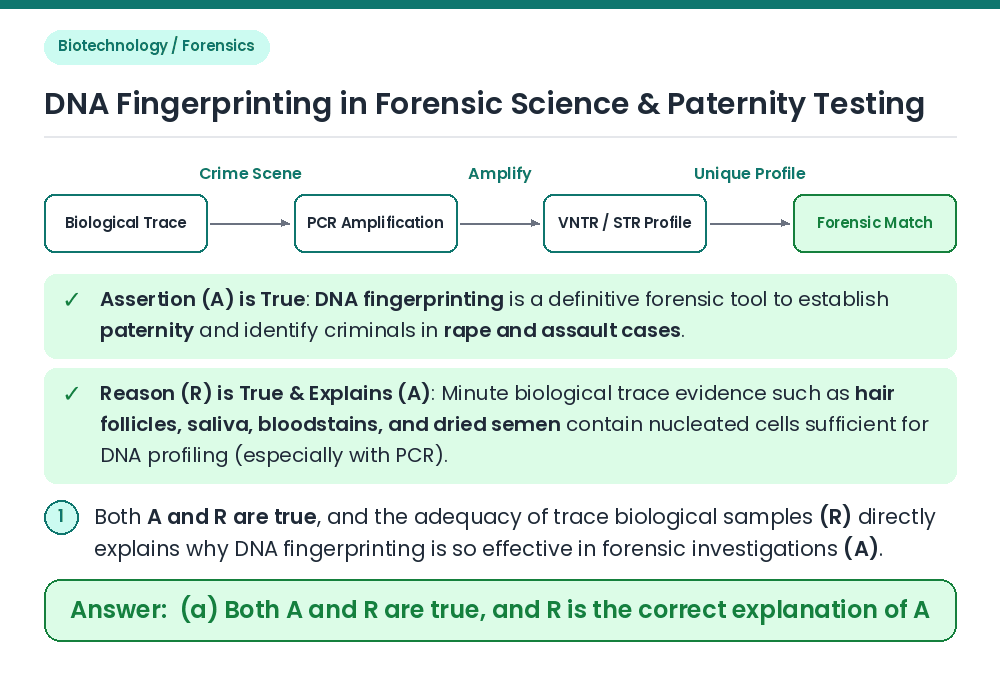
Assertion (A): “DNA Finger- printing” has become a powerful tool to establish paternity and identity of criminals in rape and assault cases. Reason (R): Trace evidences such as hairs, saliva and dried semen are adequate for DNA analysis.
Show answer & explanationShow explanation
Answer: (A) Both A and R are true, and R is the correct explanation of A
Concept: DNA fingerprinting (DNA profiling), developed by Sir Alec Jeffreys in 1984, identifies individuals based on polymorphisms in Variable Number of Tandem Repeats (VNTRs) and Short Tandem Repeats (STRs). Evaluate A & R: Because every individual (except identical twins) has a unique DNA profile inherited 50% from each parent, DNA fingerprinting accurately establishes paternity and identifies perpetrators in rape and assault cases (A is true) ⇒ Even minute trace samples found at crime scenes — such as hair roots, saliva, skin cells, and dried semen — yield enough DNA (amplified via Polymerase Chain Reaction, PCR) for analysis (R is true and explains A). Result: Both A and R are true, and R is the correct explanation of A. Related Facts: • Father of Indian DNA Fingerprinting: Dr. Lalji Singh at the Centre for Cellular and Molecular Biology (CCMB), Hyderabad. • PCR Technique: Invented by Kary Mullis in 1983 (Nobel Prize, 1993) to amplify trace quantities of DNA millions of times. Correct Answer: (a) Both A and R are true, and R is the correct explanation of A