Civil Services Examination · Question 1
In what way does the Indian Parliament exercise control over the administration?
Show answer & explanationShow explanation
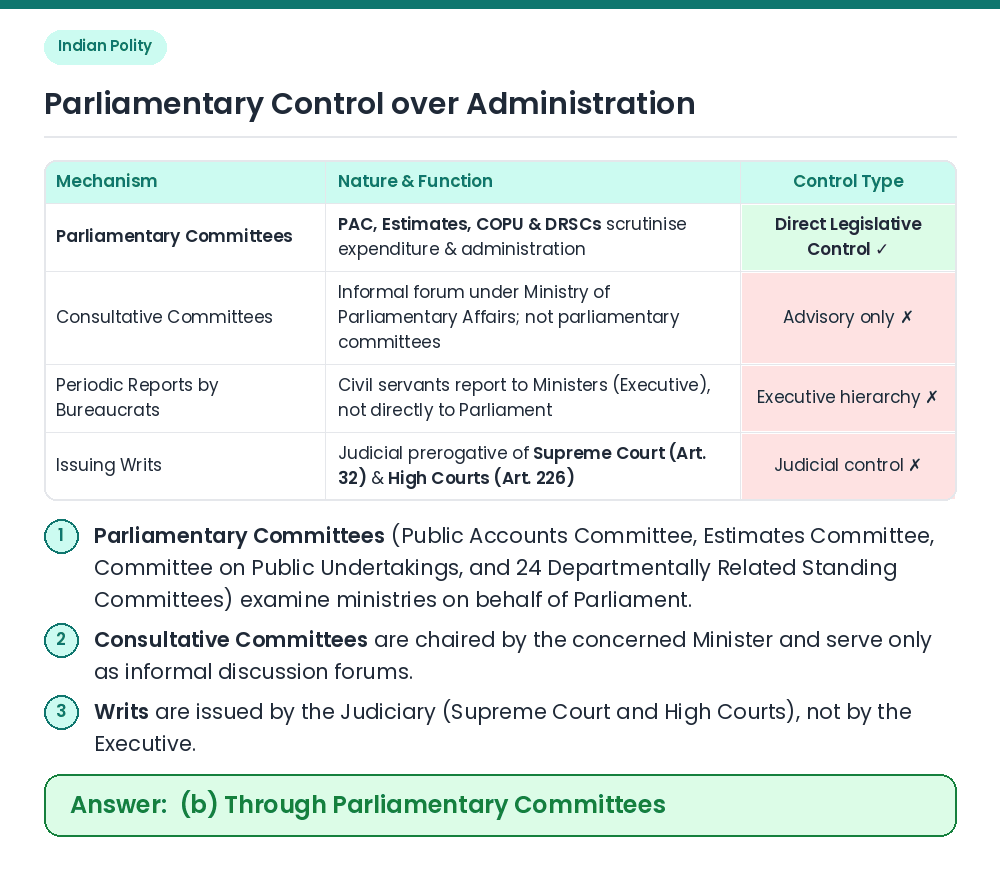
Answer: (B) Through Parliamentary Committees
Concept: In India's parliamentary system, the Executive is collectively responsible to the Legislature (Article 75(3)), and Parliament exercises detailed oversight over administration through its committees. Evaluate Parliamentary Committees: ⇒ Financial Committees (PAC, Estimates Committee, COPU) and Departmentally Related Standing Committees (DRSCs) scrutinise ministry budgets, CAG audit reports, and policy implementation on a continuous basis. Eliminate other options: ⇒ Consultative Committees are informal forums attached to ministries; administrators report to their Ministers rather than directly to Parliament; and writs are issued by the Supreme Court (Article 32) and High Courts (Article 226), not by the Executive. Result: The Indian Parliament exercises control over the administration through Parliamentary Committees. Related Facts: • Public Accounts Committee (PAC): First set up in 1921 under the Government of India Act, 1919; consists of 22 members (15 from Lok Sabha and 7 from Rajya Sabha). • Estimates Committee: The largest parliamentary committee with 30 members, all drawn exclusively from the Lok Sabha. • Departmentally Related Standing Committees (DRSCs): 24 standing committees (established in 1993) cover all central ministries with 31 members each (21 Lok Sabha + 10 Rajya Sabha). Correct Answer: (b) Through Parliamentary Committees