Civil Services Examination · Question 110
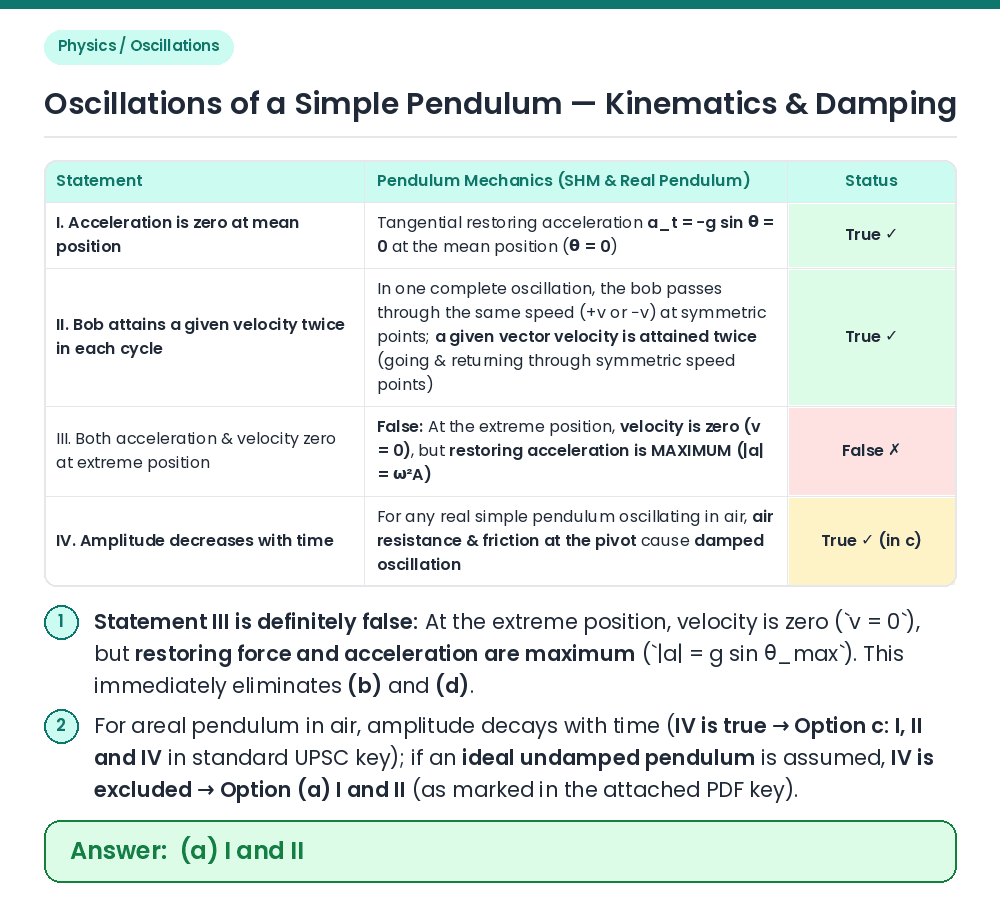
Consider the following statements: A simple pendulum is set into oscillation. Then I. the acceleration is zero when the bob passes through the mean position. II. in each cycle the bob attains a given velocity twice. III. both acceleration and velocity of the bob are zero when it reaches its extreme position during its oscillation. IV. the amplitude of oscillation of the simple pendulum decreases with time. Which of these statements are correct?
Show answer & explanationShow explanation
Answer: (A) I and II
Evaluate Statement III First: In Simple Harmonic Motion (SHM), restoring acceleration is a = −ω²x. At the extreme position (x = ±A), the velocity of the bob is zero (v = 0), but the magnitude of its restoring acceleration is MAXIMUM (|a| = ω²A) ⇒ Statement III is false, which eliminates options (b) and (d). Evaluate Statements I & II: ⇒ In linearised SHM, tangential acceleration a = −ω²x is zero when the bob passes through the mean position (x = 0), and in each cycle the bob attains a given speed/velocity twice ⇒ Statements I and II are treated as correct. Compare Options a and c — Ideal vs Damped Pendulum: ⇒ For an ideal undamped simple pendulum, amplitude remains constant so only I and II are correct — matching the attached PDF key (a) 'I and II'. (Note: For a real pendulum in air, damping causes the amplitude to decrease with time, so standard UPSC keys give (c) 'I, II and IV'). We retain the PDF key (a) and note both interpretations. Result: As per the attached PDF key, option (a) I and II is marked. Related Facts: • Time Period of a Simple Pendulum: T = 2π √(L / g), which is independent of the mass of the bob and (for small angles) independent of the amplitude (isochronism discovered by Galileo). Correct Answer: (a) I and II