Civil Services Examination · Question 116
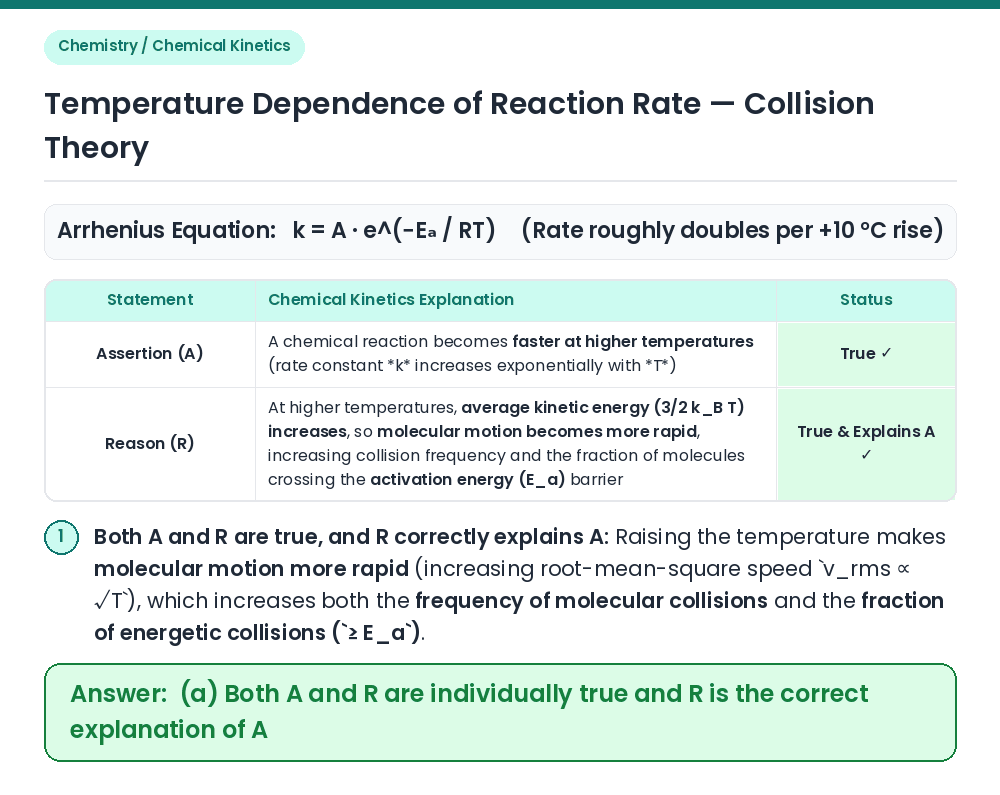
Assertion (A): A Chemical reaction becomes faster at higher temperatures. Reason (R): At higher temperatures, molecular motion becomes more rapid.
Show answer & explanationShow explanation
Answer: (A) Both A and R are individually true and R is the correct explanation of A
Evaluate Assertion A: According to chemical kinetics and the Arrhenius equation (k = A e^(−E_a / RT)), the rate of almost all chemical reactions increases markedly with an increase in temperature (for many reactions near room temperature, the rate approximately doubles or triples for every 10 °C rise in temperature) ⇒ Assertion (A) is true. Evaluate Reason R: ⇒ According to the Kinetic Theory of Matter, average translational kinetic energy is directly proportional to absolute temperature (KE_avg = 3/2 k_B T). At higher temperatures, molecular motion becomes more rapid, leading to more frequent and more energetic collisions that overcome the activation energy barrier ⇒ Reason (R) is true and is the correct explanation of (A). Result: Both A and R are individually true and R is the correct explanation of A. Related Facts: • Role of a Catalyst: A positive catalyst speeds up a chemical reaction by providing an alternative reaction pathway with a 'lower Activation Energy (E_a)' without altering the equilibrium constant or ΔG. Correct Answer: (a) Both A and R are individually true and R is the correct explanation of A