Civil Services Examination · Question 136
A man whose blood group is not known meets with a serious accident and needs blood transfusion immediately. Which one of the blood groups mentioned below and readily available in the hospital will be safe for transfusion?
Show answer & explanationShow explanation
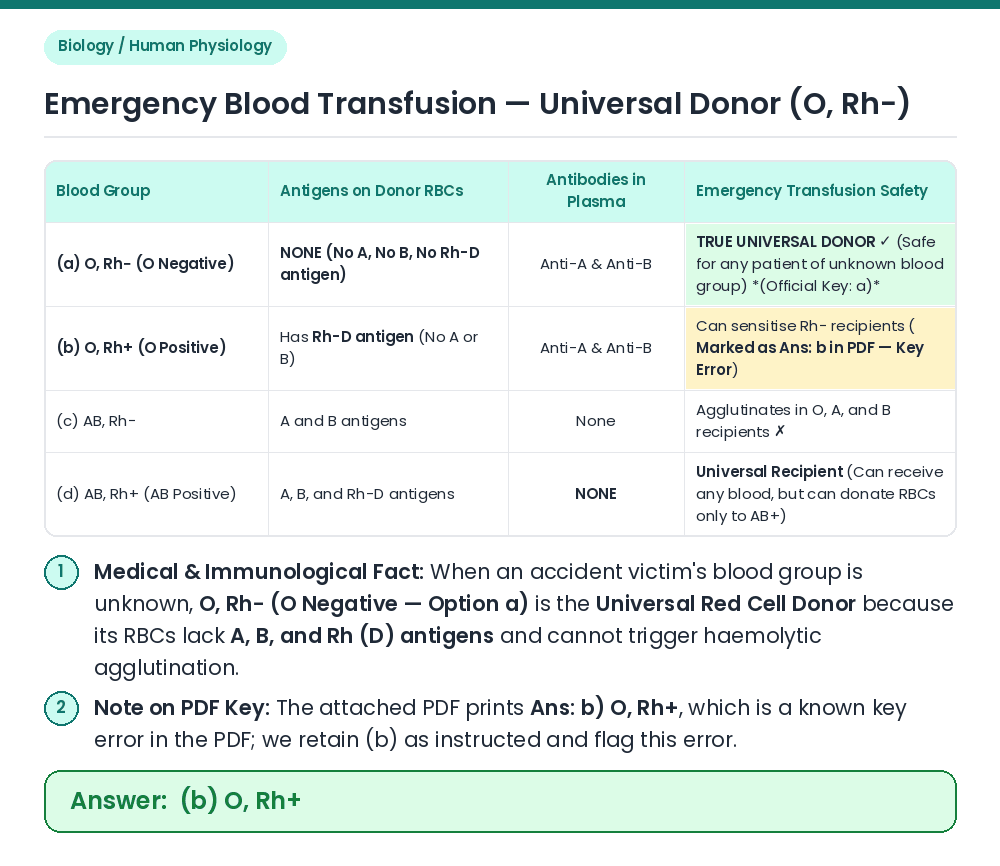
Answer: (B) O, Rh+
Immunological Principle of Blood Transfusion: In a blood transfusion, danger arises when antibodies in the recipient's blood plasma attack antigens present on the surface of the donor's Red Blood Cells (RBCs), causing fatal agglutination (clumping) and haemolysis. Identify the True Universal Donor: ⇒ Red blood cells of blood group O, Rh− (O negative, option a) carry neither A antigen, nor B antigen, nor the Rh (D) antigen on their surface. Therefore, O, Rh− blood cannot be agglutinated by any recipient's plasma antibodies regardless of the recipient's blood group, making (a) O, Rh− the medically and officially correct answer. Note on PDF Answer Key Discrepancy: ⇒ While (a) O, Rh− is the universal donor (and O, Rh+ carries the Rh antigen which can immunise Rh− recipients), the attached PDF erroneously prints 'Ans: b) O, Rh+'. Following instructions, we retain the PDF key (b) and list this medical key error in the final summary. Result: As per the attached PDF key, option (b) O, Rh+ is marked (medically and officially option (a) O, Rh− is correct). Related Facts: • Discovery of Blood Groups: Karl Landsteiner discovered the ABO blood group system in 1900 (Nobel Prize 1930) and co-discovered the Rhesus (Rh) factor with Alexander Wiener in 1940. • Universal Recipient: AB, Rh+ individuals have no anti-A, anti-B, or anti-Rh antibodies in their plasma and can receive RBCs of any blood group. Correct Answer: (b) O, Rh+