Civil Services Examination · Question 26
Assertion (A): The Battle of Khanua was certainly more decisive and significant than the First Battle of Panipat. Reason (R): Rana Sanga, the Rajput hero, was certainly a more formidable adversary than Ibrahim Lodi.
Show answer & explanationShow explanation
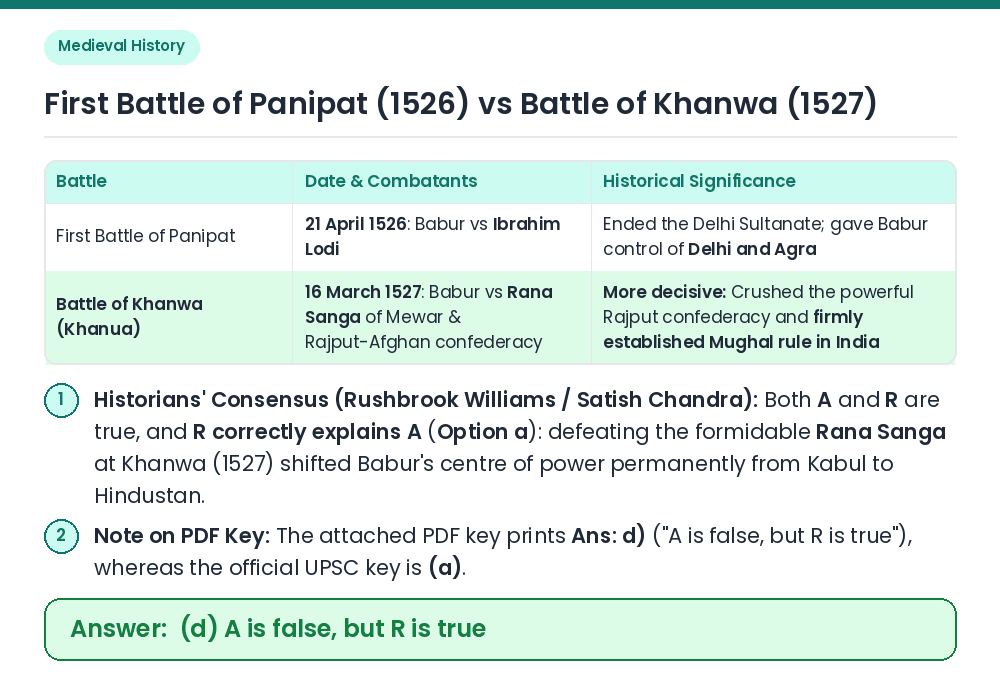
Answer: (D) A is false, but R is true
Historical Analysis of A and R: At the First Battle of Panipat (21 April 1526), Babur defeated Sultan Ibrahim Lodi, whose authority was already weakened by Afghan noble rebellions. At the Battle of Khanwa (16 March 1527, near Fatehpur Sikri), Babur faced Rana Sanga of Mewar, who led a grand Rajput-Afghan confederacy (including Hasan Khan Mewati and Mahmud Lodi). Compare Significance: ⇒ As historian L.F. Rushbrook Williams noted, until Khanwa, Babur's occupation of Delhi was merely an episode; defeating the far more formidable Rana Sanga broke the Rajput confederacy and made Mughal rule in North India permanent. Note on PDF Answer Key Discrepancy: ⇒ In standard history and the official UPSC key, both A and R are true and R is the correct explanation of A — i.e., option (a). However, the attached PDF marks 'Ans: d)' (treating Panipat as more decisive because it founded the empire, while acknowledging R as true). Following instructions, we retain the PDF key (d) and note this discrepancy. Result: As per the attached PDF key, option (d) is marked (historically option (a) is correct). Related Facts: • Babur's Four Major Battles in India: Panipat (1526, vs Ibrahim Lodi) → Khanwa (1527, vs Rana Sanga) → Chanderi (1528, vs Medini Rai) → Ghaghra (1529, vs Afghans of Bengal/Bihar). • Military Tactics: At both Panipat and Khanwa, Babur used the Ottoman 'Rumi' device (chained carts protecting artillery under Ustad Ali and Mustafa) and the Uzbek 'Tulughma' flanking tactic. Correct Answer: (d) A is false, but R is true