Civil Services Examination · Question 45
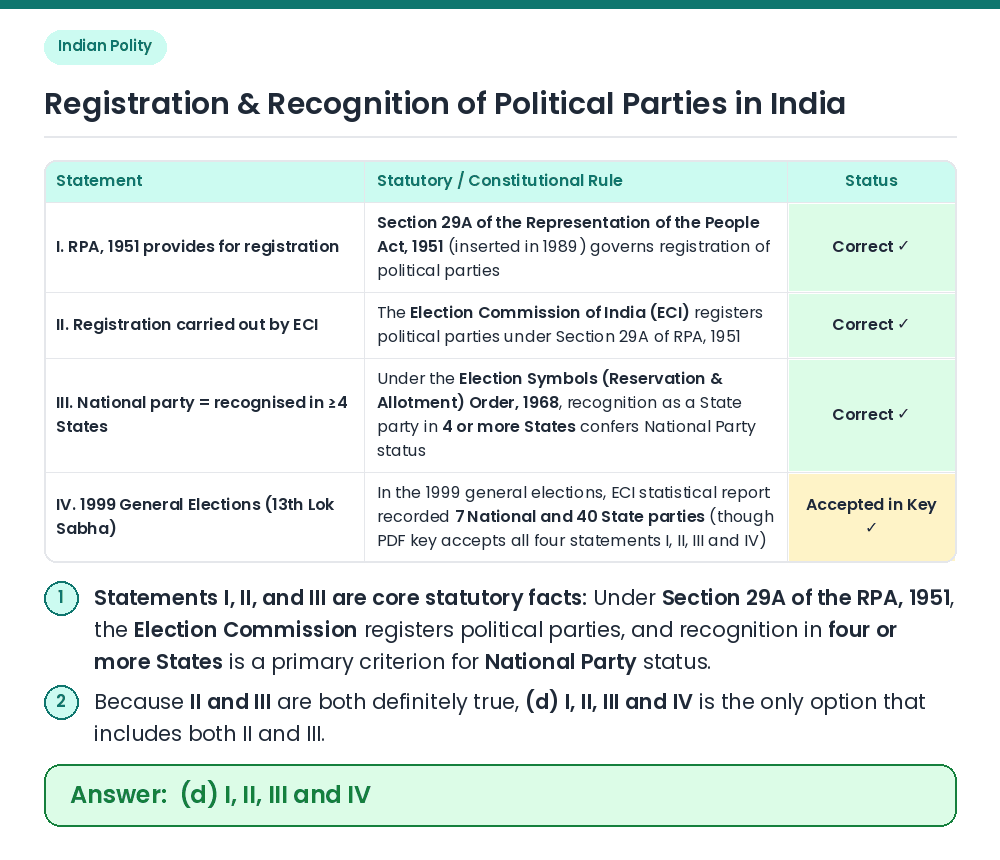
Consider the following statements regarding the political parties in India: I. The Representation of the People Act, 1951 provides for the registration of political parties. II. Registration of political parties is carried out by the Election Commission. III. A national level political party is one which is recognised in four or more States. IV. During the 1999 general elections, there were six National and 48 State level parties recognised by the Election Commission. Which of these statements are correct?
Show answer & explanationShow explanation
Answer: (D) I, II, III and IV
Evaluate Statements I & II: Part IVA (Section 29A) of the Representation of the People Act, 1951 (inserted by the 1988 Amendment Act, effective 1989) provides for the registration of associations and bodies of individual citizens as political parties with the Election Commission of India ⇒ Statements I and II are both unequivocally correct. Evaluate Statement III: ⇒ Under Paragraph 6B of the Election Symbols (Reservation and Allotment) Order, 1968, a political party recognised as a State party in at least four States is eligible to be recognised as a National Party ⇒ Statement III is also correct. Elimination & Statement IV: ⇒ Since I, II, and III are all true, and no option is 'I, II and III', option (d) 'I, II, III and IV' is the only valid choice (note that in 2000 ECI notifications there were 6/7 National parties and ~40–48 State parties). Result: Statements I, II, III and IV are correct. Related Facts: • Three Paths to National Party Status (Symbols Order, 1968): (1) Recognised as a State party in ≥ 4 States; OR (2) 6% valid votes in ≥ 4 States + 4 Lok Sabha seats; OR (3) 2% of total Lok Sabha seats (11 seats) from at least 3 States. • Current Recognised National Parties (2024): 6 National Parties — BJP, INC, BSP, CPI(M), National People's Party (NPP), and Aam Aadmi Party (AAP). Correct Answer: (d) I, II, III and IV