Civil Services Examination · Question 124
Which are the materials generally employed as solder in soldering operation in electronics?
Show answer & explanationShow explanation
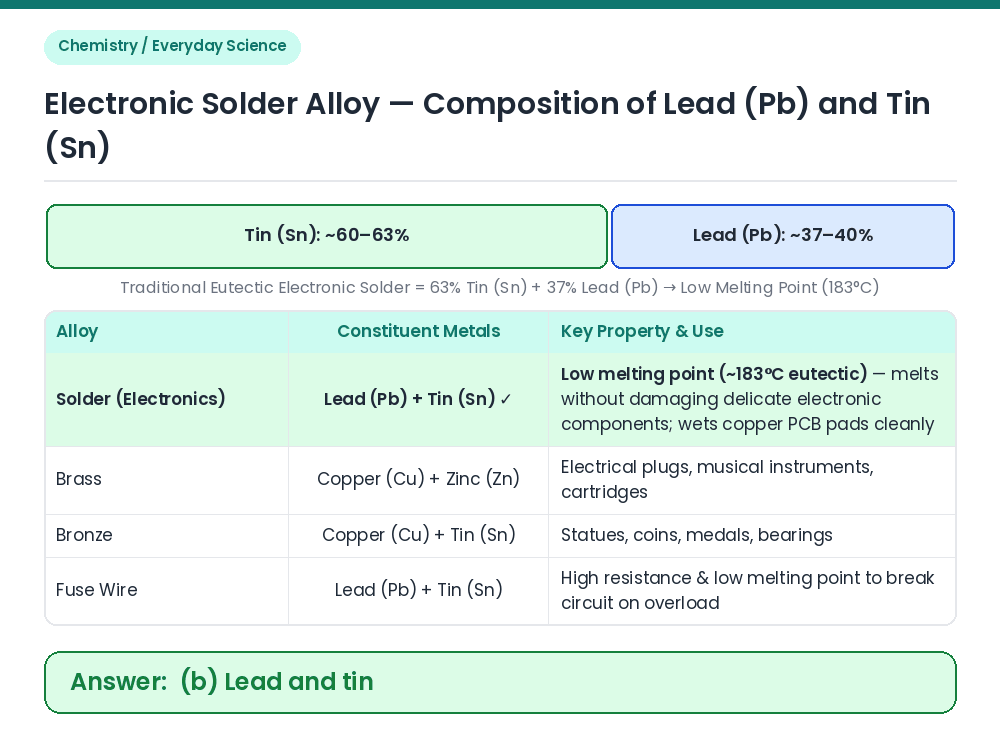
Answer: (B) Lead and tin
Given / Concept: Soldering is a process of joining metallic electronic leads to printed circuit boards (PCBs) by melting a filler metal alloy ('solder') that has a lower melting point than the workpieces. Identify the Alloy Constituents: Traditional soft solder used in electronics is an alloy of Tin (Sn, typically 60% or 63%) and Lead (Pb, typically 40% or 37%). Why Lead–Tin Works: Pure Tin melts at 232°C and pure Lead melts at 327°C, but their eutectic alloy (63% Sn – 37% Pb) melts sharply at just 183°C, allowing rapid, reliable electrical joints without thermally damaging sensitive semiconductors.. Result: Lead and tin are employed as solder. Related Facts: • Lead-Free RoHS Solder: Under modern RoHS environmental norms, SAC alloys (Tin–Silver–Copper, Sn-Ag-Cu) are increasingly used as lead-free electronic solders. Correct Answer: (b) Lead and tin