Civil Services Examination · Question 127
Consider the following statements: 1. The Ikshvaku rulers of southern India were antagonistic towards Buddhism. 2. The Pala rulers of Eastern India were patrons of Buddhism. Which of the statements given above is/are correct?
Show answer & explanationShow explanation
Answer: (B) 2 only
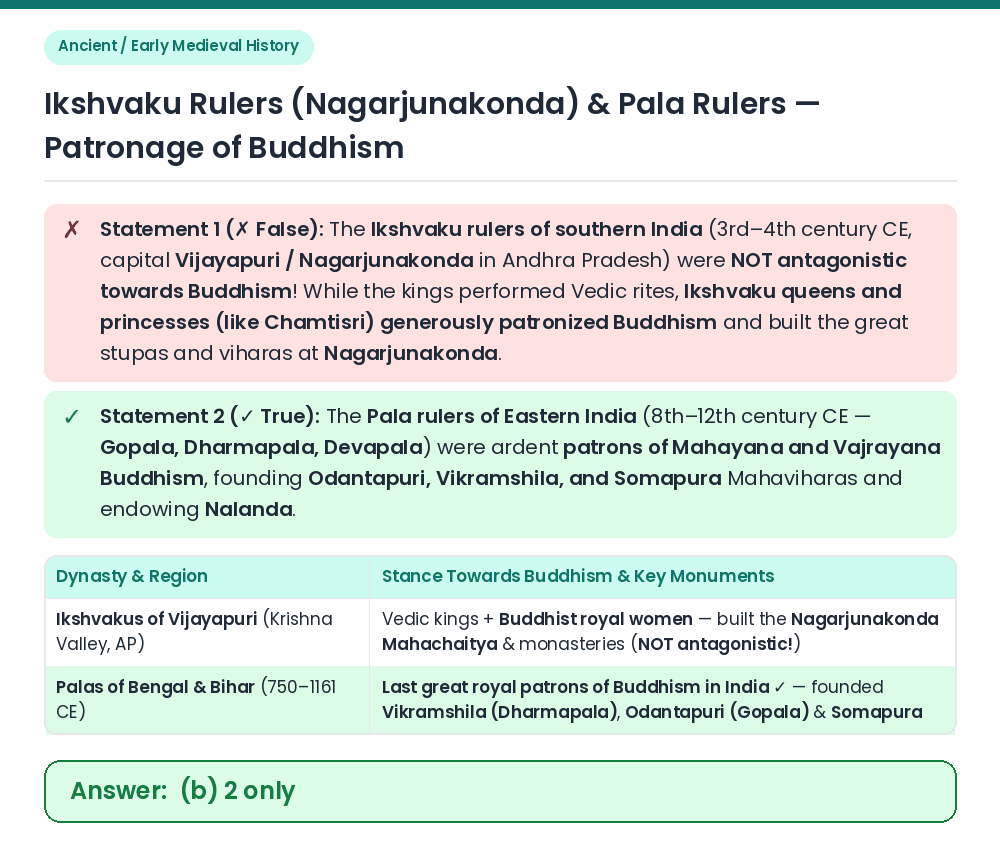
Given / Concept: Evaluate the religious policies of the Andhra Ikshvaku dynasty (3rd–4th century CE) and the Pala dynasty of Bengal and Bihar (8th–12th century CE) towards Buddhism. Check Statement 1: The Ikshvakus of Vijayapuri (Nagarjunakonda in the Krishna River valley, who succeeded the Satavahanas) were NOT antagonistic towards Buddhism. Although kings like Vasishthiputra Chamtamula performed Vedic sacrifices (Ashvamedha, Vajapeya), the royal ladies (such as Princess Chamtisri) and later rulers were munificent patrons of Buddhism, making Nagarjunakonda one of the greatest Buddhist monastic centres in South India ⇒ Statement 1 is incorrect. Check Statement 2: The Pala kings of Eastern India (Gopala, Dharmapala, Devapala, Mahipala) were devout Buddhists (called 'Paramasaugata') who patronized Nalanda and founded the great Buddhist universities of Odantapuri, Vikramshila, and Somapura ⇒ Statement 2 is correct. Result: Only Statement 2 is correct. Related Facts: • Devapala's Nalanda Grant: Pala ruler Devapala granted five villages for the maintenance of a monastery built at Nalanda by the Sailendra King Balaputradeva of Suvarnadvipa (Sumatra/Java). Correct Answer: (b) 2 only