Civil Services Examination · Question 137
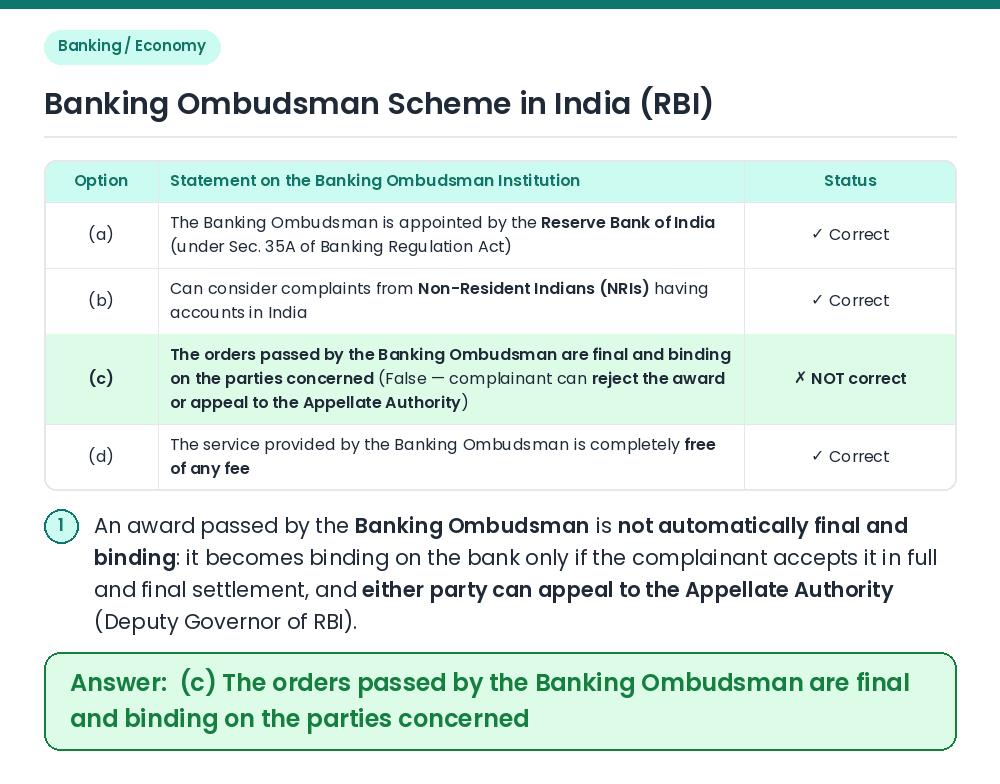
With reference to the institution of Banking Ombudsman in India, which one of the following statements is not correct?
Show answer & explanationShow explanation
Answer: (C) The orders passed by the Banking Ombudsman are final and binding on the parties concerned
Concept: The Banking Ombudsman Scheme was introduced by the RBI in 1995 (revised in 2006) under Section 35A of the Banking Regulation Act, 1949 to provide a quick and cost-free forum for resolving customer complaints relating to deficiency in banking services. Verify True Statements: The Banking Ombudsman is a senior official appointed by the RBI (a ✓), entertains complaints from both residents and NRIs holding accounts in India (b ✓), and charges zero fee for filing or resolving complaints (d ✓). Identify False Statement: The award passed by the Banking Ombudsman is NOT unconditionally final and binding; the complainant is free to accept or reject the award, and either the bank or the customer can file an appeal before the Appellate Authority (a Deputy Governor of the RBI) within 30 days ⇒ Statement (c) is not correct. Result: Option (c) is the incorrect statement. Related Facts: • In November 2021, the RBI merged three separate ombudsman schemes (for Banks, NBFCs, and Digital Transactions) into the unified 'Reserve Bank - Integrated Ombudsman Scheme (RB-IOS), 2021' based on the 'One Nation One Ombudsman' principle. Correct Answer: (c) The orders passed by the Banking Ombudsman are final and binding on the parties concerned