Civil Services Examination · Question 23
A pesticide which is a chlorinated hydrocarbon is sprayed on a food crop. The food chain is: Food crop – Rat – Snake – Hawk. In this food chain, the highest concentration of the pesticide would accumulate in which one of the following?
Show answer & explanationShow explanation
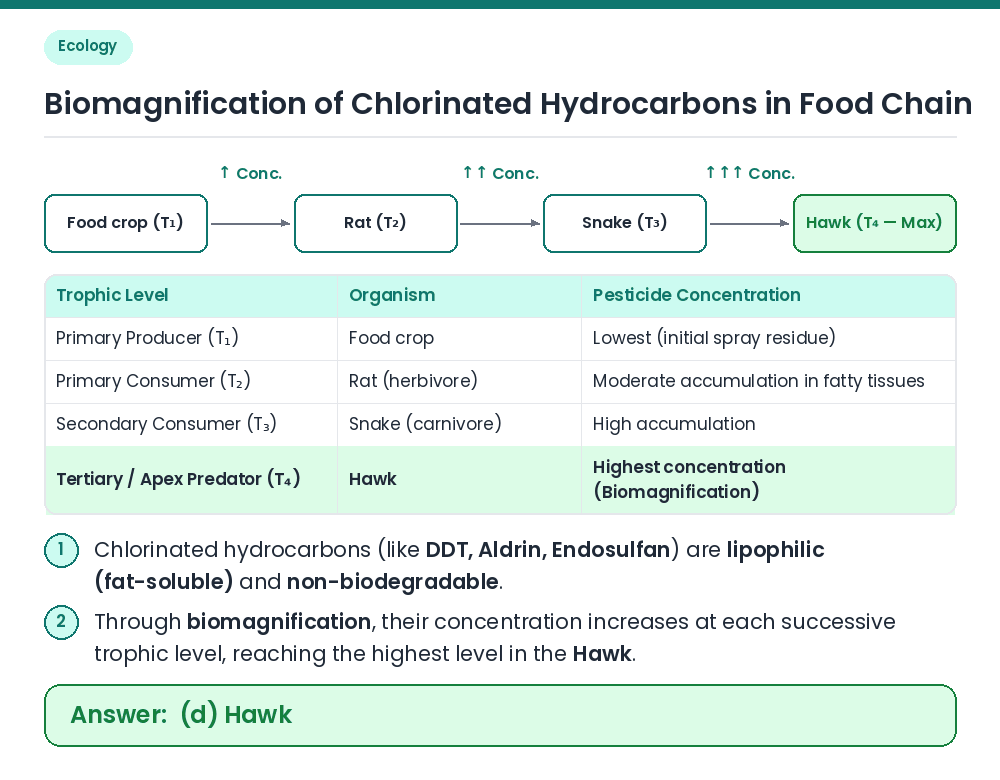
Answer: (D) Hawk
Concept: Biomagnification (biological magnification) is the progressive increase in the concentration of persistent, non-biodegradable toxic substances at each successive trophic level of a food chain. Property of Chlorinated Hydrocarbons: Chlorinated hydrocarbons (such as DDT, BHC, Dieldrin) are fat-soluble (lipophilic) and cannot be metabolized or excreted in urine by organisms. Trophic Progression: As rats eat many food crops, snakes eat many rats, and hawks eat many snakes, the toxin accumulates in adipose tissues and multiplies at each step: Food crop < Rat < Snake < Hawk. Result: The highest concentration of the pesticide accumulates in the apex predator, the Hawk. Related Facts: • High DDT accumulation in predatory birds (like hawks, bald eagles, and peregrine falcons) interferes with calcium metabolism, causing premature eggshell thinning. • Bioaccumulation occurs within a single organism over its lifetime, whereas biomagnification occurs across trophic levels in a food chain. Correct Answer: (d) Hawk