Civil Services Examination · Question 21
Widespread resistance of malarial parasite to drugs like chloroquine has prompted attempts to develop a malarial vaccine to combat malaria. Why is it difficult to develop an effective malaria vaccine?
Show answer & explanationShow explanation
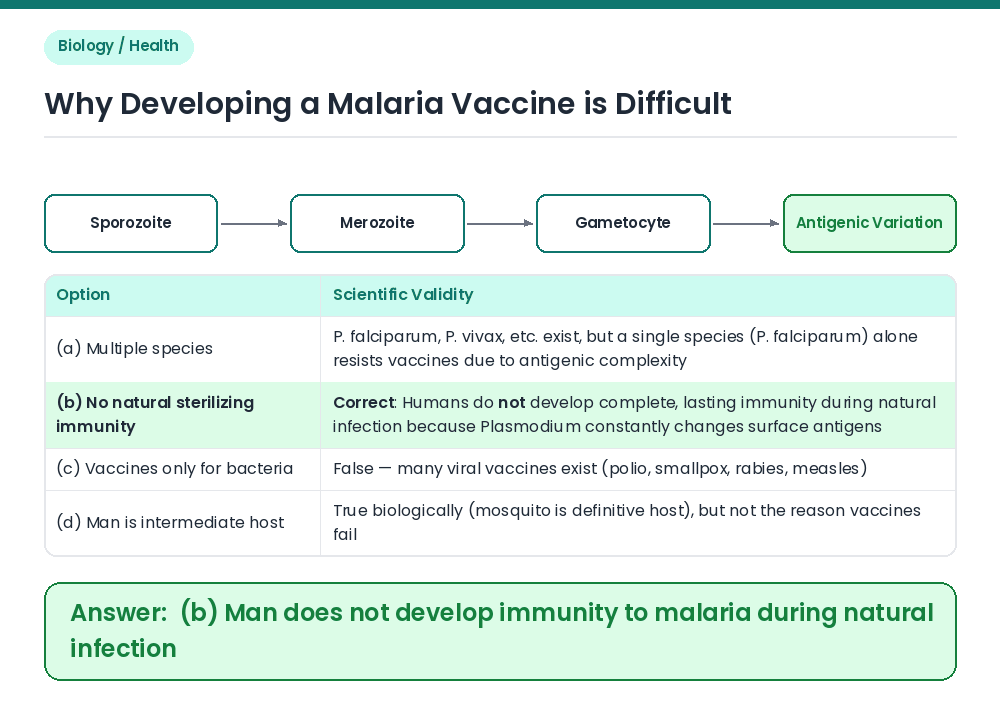
Answer: (B) Man does not develop immunity to malaria during natural infection
Concept: Malaria is caused by the protozoan parasite Plasmodium, which has a complex multi-stage life cycle across the female Anopheles mosquito and humans. Immunological Challenge: Unlike viral or bacterial infections (like measles or smallpox) where surviving one infection confers lifelong immunity, humans do not develop complete sterilizing immunity to malaria during natural infection because Plasmodium expresses thousands of genes and constantly alters its surface proteins (antigenic variation). Eliminate Other Options: Vaccines are routinely made against viruses (so c is false); while multiple species exist and humans are the intermediate host, the core barrier to vaccine efficacy is the absence of durable natural immune memory. Result: Statement (b) is the primary reason why developing an effective malaria vaccine is difficult. Related Facts: • The female Anopheles mosquito is the definitive (primary) host where sexual reproduction of Plasmodium occurs, while humans are the intermediate (secondary) host. • Recently, the WHO recommended the RTS,S/AS01 (Mosquirix) and R21/Matrix-M vaccines against Plasmodium falciparum malaria with moderate efficacy. Correct Answer: (b) Man does not develop immunity to malaria during natural infection