Civil Services Examination · Question 55
Which amongst the following provided a common factor for tribal insurrection in India in the 19th century ?
Show answer & explanationShow explanation
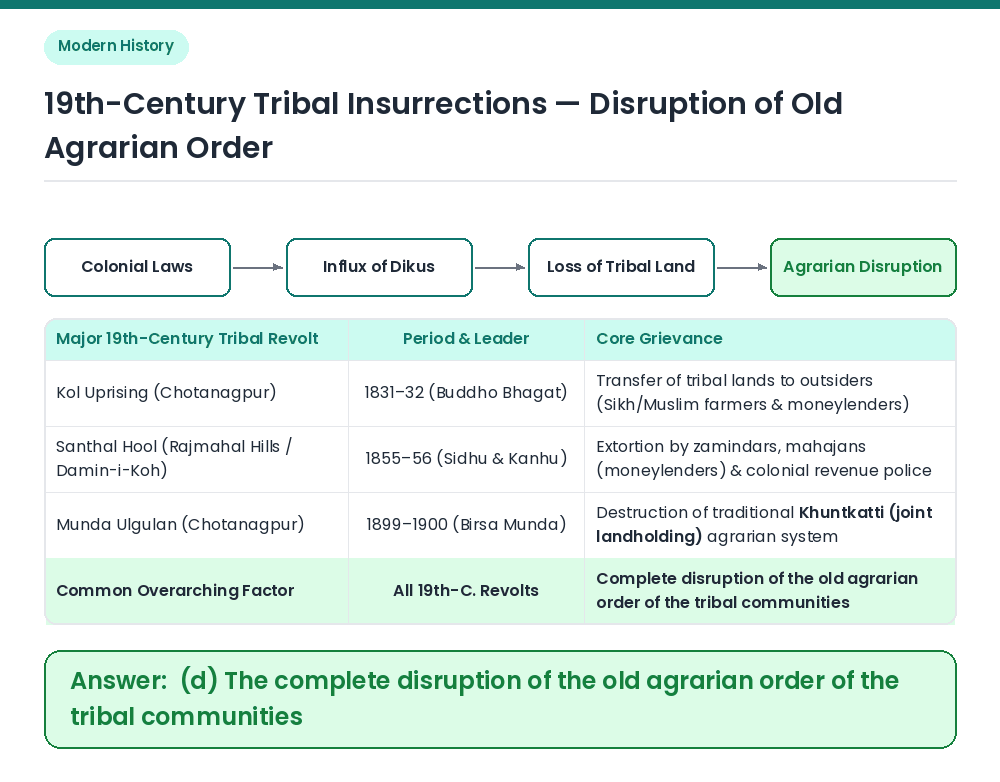
Answer: (D) The complete disruption of the old agrarian order of the tribal communities
Compare specific factors vs the comprehensive root cause: While options (a), (b), and (c) describe individual colonial pressures — new land revenue/forest taxes, Christian missionaries, and the influx of middlemen/moneylenders/traders ('dikus') — all of them culminated in and are encompassed by option (d): the complete disruption of the old, customary, communal agrarian and forest order of the tribal communities (such as the Munda Khuntkatti system). Verify with standard history texts — Bipan Chandra, India's Struggle for Independence: Bipan Chandra explicitly writes that 'the complete disruption of the old agrarian order of the tribal communities provided the common factor for all the tribal uprisings' of the 19th century (including the Santhal, Kol, Munda, Ramosi, and Rampa rebellions). Related Facts: • Major 19th-century tribal uprisings include the Kol Mutiny (1831–32, Buddho Bhagat), Santhal Hul (1855–56, Sidhu and Kanhu), and Munda Ulgulan (1899–1900, Birsa Munda). • The Chotanagpur Tenancy Act, 1908 was enacted after Birsa Munda's movement to protect tribal Khuntkatti land rights against transfer to non-tribals (dikus). Correct Answer: (d) The complete disruption of the old agrarian order of the tribal communities