Civil Services Examination · Question 57
What is the difference between Bluetooth and Wi-Fi devices ?
Show answer & explanationShow explanation
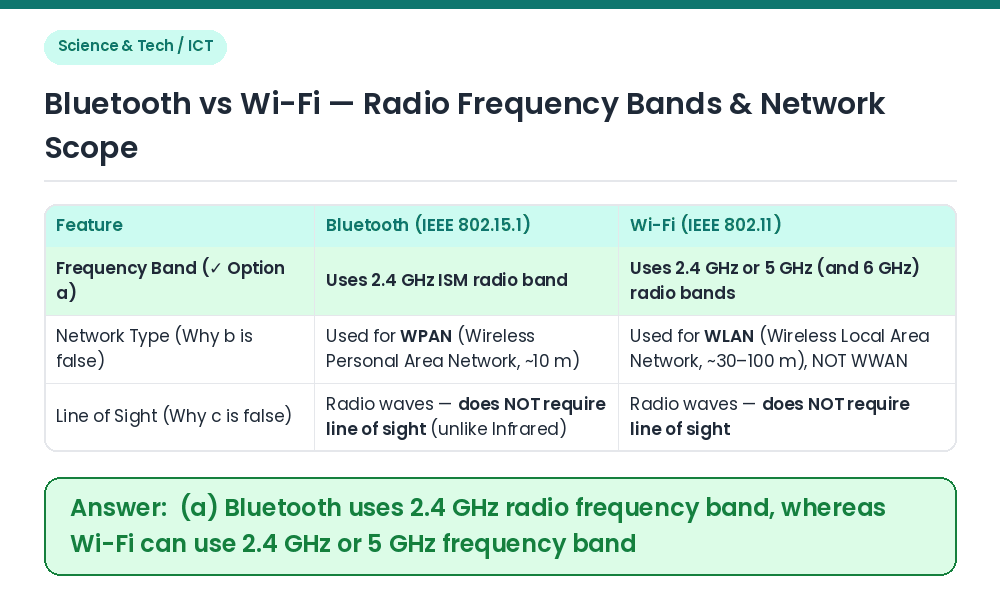
Answer: (A) Bluetooth uses 2.4 GHz radio frequency band, whereas Wi-Fi can use 2.4 GHz or 5 GHz frequency band
Compare Frequency Bands — Option a: Bluetooth operates in the unlicensed 2.4 GHz ISM (Industrial, Scientific and Medical) radio frequency band (2.402–2.480 GHz), whereas Wi-Fi (IEEE 802.11 family) operates in either the 2.4 GHz or the 5 GHz frequency band (and 6 GHz in Wi-Fi 6E/7). Option (a) is correct. Eliminate Options b and c: Option (b) is incorrect because Bluetooth creates a Wireless Personal Area Network (WPAN) while Wi-Fi creates a Wireless Local Area Network (WLAN), not a WWAN (cellular 4G/5G is WWAN). Option (c) is incorrect because both Bluetooth and Wi-Fi use omnidirectional radio waves and neither requires line-of-sight alignment (unlike Infrared/IR remotes). Related Facts: • Bluetooth (IEEE 802.15.1) operates in the 2.4 GHz ISM band for short-range Wireless Personal Area Networks (WPAN, ~10 m), whereas Wi-Fi (IEEE 802.11) operates in 2.4 GHz and 5 GHz (and 6 GHz) bands for Wireless Local Area Networks (WLAN). • Unlike infrared (IR) remotes, neither Bluetooth nor Wi-Fi requires line-of-sight because radio waves penetrate walls and obstacles. Correct Answer: (a) Bluetooth uses 2.4 GHz radio frequency band, whereas Wi-Fi can use 2.4 GHz or 5 GHz frequency band