Civil Services Examination · Question 59
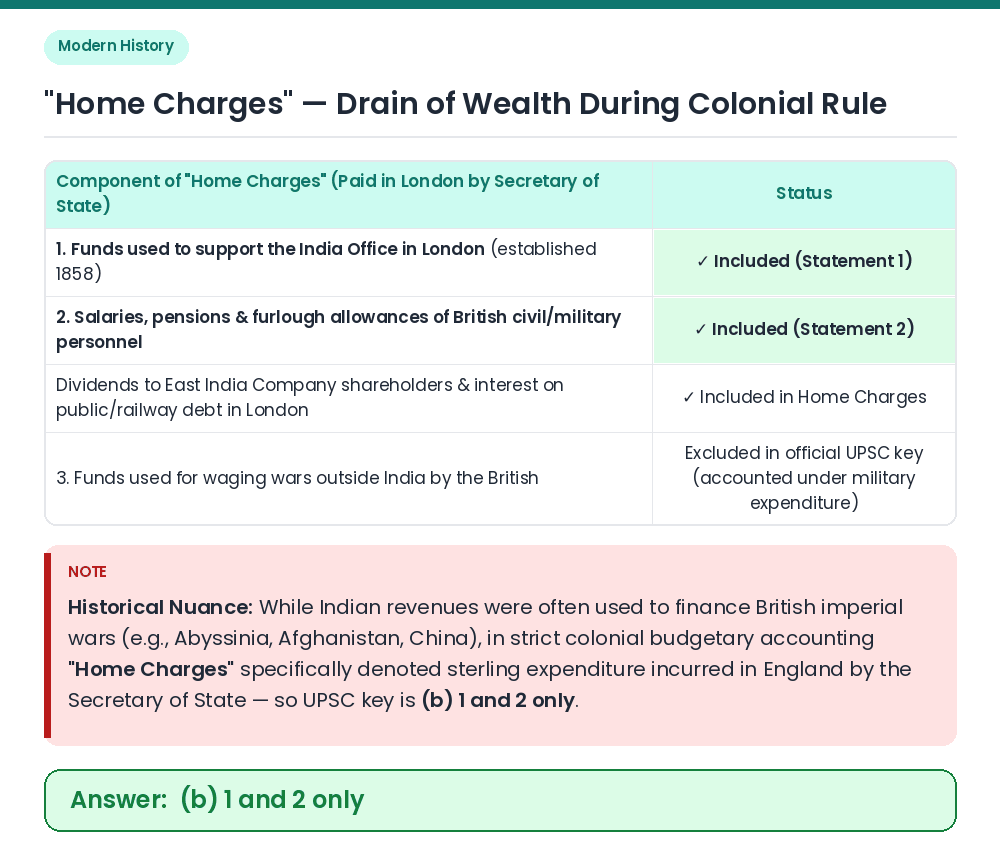
With reference to the period of colonial rule in India, "Home Charges" formed an important part of drain of wealth from India. Which of the following funds constituted "Home Charges" ? 1. Funds used to support the India Office in London. 2. Funds used to pay salaries and pensions of British personnel engaged in India. 3. Funds used for waging wars outside India by the British. Select the correct answer using the codes given below :
Show answer & explanationShow explanation
Answer: (B) 1 and 2 only
Define 'Home Charges' in the Drain of Wealth theory: Expounded by Dadabhai Naoroji (Poverty and Un-British Rule in India) and R.C. Dutt (Economic History of India), 'Home Charges' referred specifically to the sterling expenditure incurred in England ('Home') by the Secretary of State for India on behalf of the Indian Government. Identify the components: Home Charges comprised: (1) maintenance of the India Office establishment in London; (2) salaries, pensions, and furlough allowances paid in Britain to British civil and military officers who served in India; (3) dividends to East India Company shareholders and interest on Indian public debt and guaranteed railway capital raised in London. Statements 1 and 2 are correct. Note on Statement 3: Although British imperial wars outside India were frequently charged to the Indian exchequer as part of the broader drain of wealth, they were accounted under external military/war expenditure rather than the technical accounting head of 'Home Charges' in London. Thus the official UPSC key is (b) 1 and 2 only. Related Facts: • Dadabhai Naoroji first formulated the 'Drain of Wealth' theory in his paper 'England's Debt to India' (1867) and book 'Poverty and Un-British Rule in India' (1901). • The Indian National Congress officially adopted the Drain of Wealth theory at its Calcutta Session in 1896. Correct Answer: (b) 1 and 2 only