Civil Services Examination · Question 62
Aspartame is an artificial sweetener sold in the market. It consists of amino acids and provides calories like other amino acids. Yet, it is used as a low-calorie sweetening agent in food items. What is the basis of this use ?
Show answer & explanationShow explanation
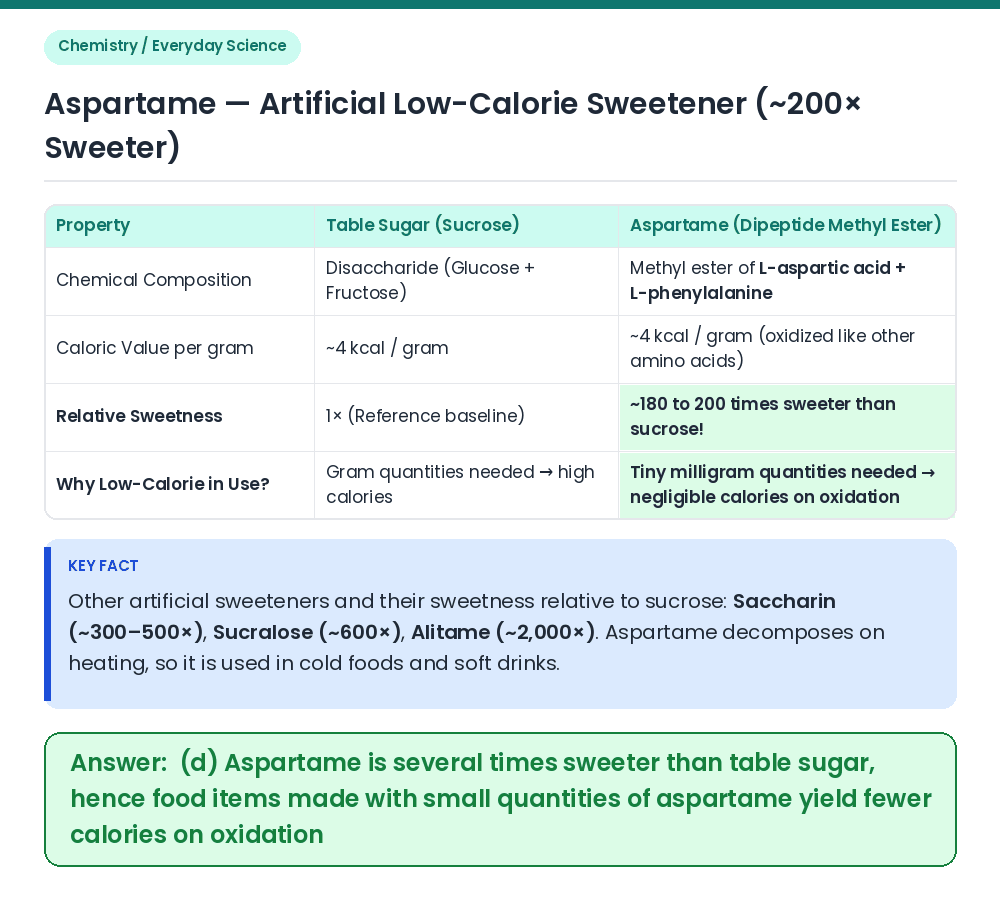
Answer: (D) Aspartame is several times sweeter than table sugar, hence food items made with small quantities of aspartame yield fewer calories on oxidation
Chemical nature of Aspartame: Aspartame is the methyl ester of a dipeptide composed of two amino acids — aspartic acid and phenylalanine. Gram for gram, it is metabolized and oxidized in the body to yield ~4 kcal/g, just like proteins/amino acids and carbohydrates. Why it acts as a low-calorie sweetener: Aspartame is approximately 180–200 times sweeter than table sugar (sucrose). Consequently, only a minuscule quantity (a few milligrams) is required to achieve the same level of sweetness, yielding virtually zero net calories when oxidized. Related Facts: • Because aspartame releases phenylalanine upon digestion, products containing it must carry a warning for people with the genetic disorder Phenylketonuria (PKU). It is also unstable at cooking/baking temperatures. • Aspartame breaks down in the body into phenylalanine, aspartic acid, and methanol, so food products containing it must carry a warning label for people with Phenylketonuria (PKU). Correct Answer: (d) Aspartame is several times sweeter than table sugar, hence food items made with small quantities of aspartame yield fewer calories on oxidation