Civil Services Examination · Question 74
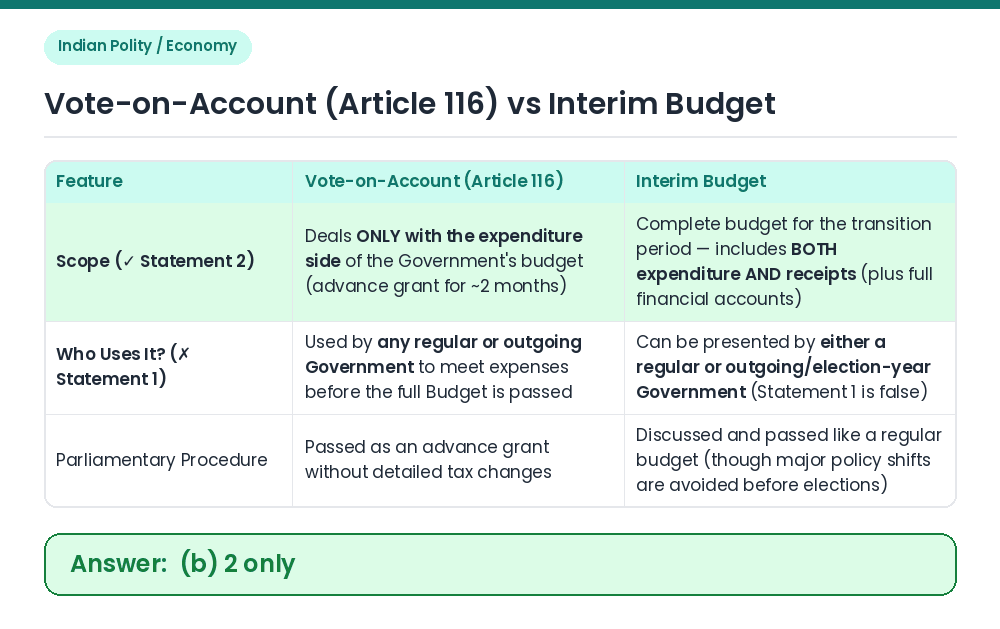
What is the difference between "vote-on-account" and "interim budget" ? 1. The provision of a "vote-on-account" is used by a regular Government, while an "interim budget" is a provision used by a caretaker Government. 2. A "vote-on-account" only deals with the expenditure in Government's budget, while an "interim budget" includes both expenditure and receipts. Which of the statements given above is/are correct ?
Show answer & explanationShow explanation
Answer: (B) 2 only
Analyze Statement 1: A Vote-on-Account (Article 116(1)(a)) is an upfront parliamentary grant enabling the Government to withdraw money from the Consolidated Fund of India to meet routine administrative expenditure for a part of the financial year (usually 2 months, roughly 1/6th of total estimated expenditure) until the Appropriation Bill is passed. Both a regular government and an election-year/outgoing government can use either an Interim Budget or a Vote-on-Account (in fact, an Interim Budget itself includes a Vote-on-Account for the interim months). Statement 1 is incorrect. Analyze Statement 2: A Vote-on-Account deals strictly with the expenditure side of the government's budget, whereas an Interim Budget is a complete set of financial accounts covering both expenditure and receipts (revenue/capital). Statement 2 is correct. Related Facts: • From 2017 onwards, the Union Budget presentation was advanced from the last working day of February to 1 February so that the full Appropriation Bill is passed before the new financial year starts on 1 April. • Under Article 116, the Lok Sabha is empowered to make three special grants: Vote-on-Account, Vote of Credit (blank cheque for national emergencies), and Exceptional Grant. Correct Answer: (b) 2 only