Civil Services Examination · Question 76
The 2004 Tsunami made people realize that mangroves can serve as a reliable safety hedge against coastal calamities. How do mangroves function as a safety hedge ?
Show answer & explanationShow explanation
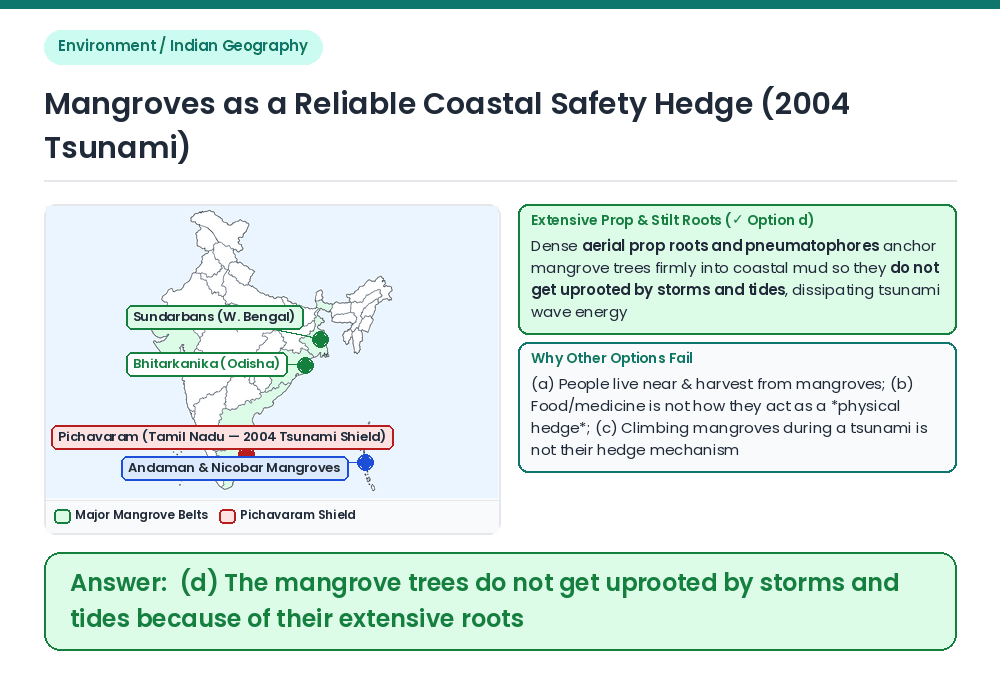
Answer: (D) The mangrove trees do not get uprooted by storms and tides because of their extensive roots
Understand the biomechanical role of mangrove roots: Mangrove species (such as Rhizophora and Avicennia) possess a dense, intertwined network of aerial stilt/prop roots, buttress roots, and pneumatophores anchored deeply in soft coastal sediments. How they act as a coastal safety hedge: Because of their extensive root system, mangrove trees do not get uprooted by cyclonic storm surges, high tides, or tsunami waves; instead, the dense root matrix creates hydraulic drag that absorbs and dissipates wave energy and traps coastal sediment. Related Facts: • During the 26 December 2004 Indian Ocean Tsunami, villages behind the Pichavaram and Muthupet mangrove forests in Tamil Nadu suffered minimal damage compared to exposed coastal stretches. • According to the India State of Forest Report (ISFR), West Bengal (Sundarbans) has the largest mangrove cover in India, followed by Gujarat and Andaman & Nicobar Islands. Correct Answer: (d) The mangrove trees do not get uprooted by storms and tides because of their extensive roots