Civil Services Examination · Question 78
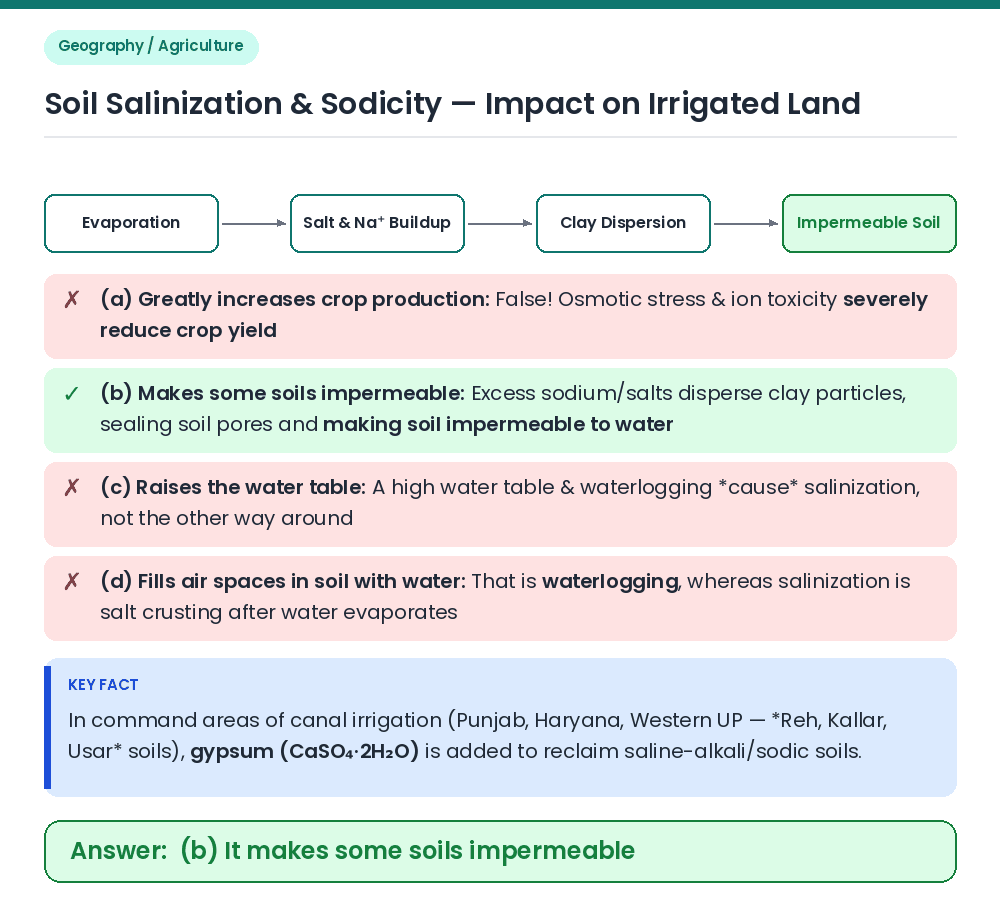
Salinization occurs when the irrigation water accumulated in the soil evaporates, leaving behind salts and minerals. What are the effects of salinization on the irrigated land ?
Show answer & explanationShow explanation
Answer: (B) It makes some soils impermeable
Understand the physical effect of Salinization/Sodification on soil structure: When irrigation water evaporates and leaves behind high concentrations of soluble salts (especially sodium ions, Na⁺), the excess sodium replaces calcium and magnesium on clay colloids, causing deflocculation (dispersion) of soil aggregates. Why soil becomes impermeable: The dispersed fine clay particles clog the microscopic pore spaces in the soil and form a hard surface crust (hardpan), which reduces infiltration and makes the soil impermeable to water and air. Related Facts: • Options (c) and (d) describe waterlogging (which is a cause of salinization, not an effect of water evaporating), while option (a) is opposite to reality since salinization causes physiological drought and stunts crop growth. • Saline and sodic soils in India are locally known as Reh, Kallar, Usar, Thur, Karl, and Chopan, and are reclaimed using Gypsum (CaSO₄·2H₂O) and leaching. Correct Answer: (b) It makes some soils impermeable