Civil Services Examination · Question 81
An artificial satellite orbiting around the Earth does not fall down. This is so because the attraction of Earth
Show answer & explanationShow explanation
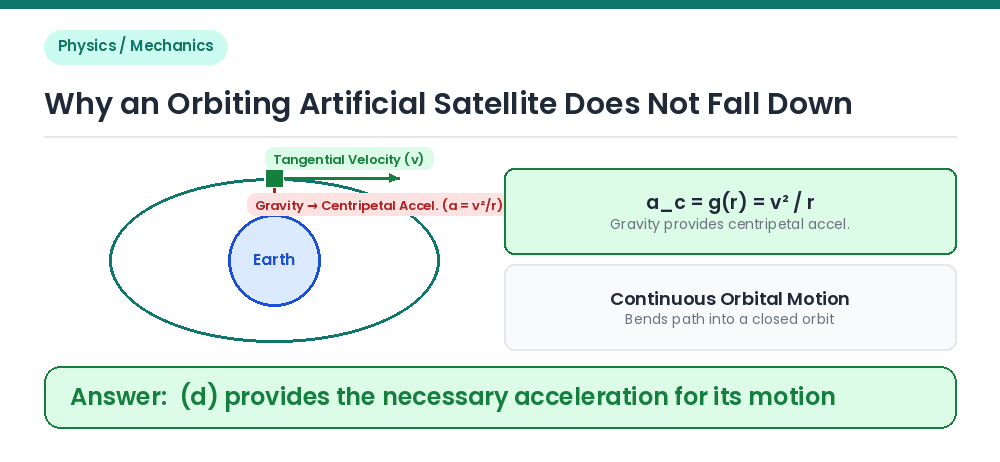
Answer: (D) provides the necessary acceleration for its motion
Physics of circular orbital motion: A force perpendicular to the velocity of a body does not change its speed, but continuously changes its direction — producing centripetal acceleration (a_c = v²/r) directed toward the centre of the circular path. Role of Earth's gravitational attraction: For an orbiting satellite, the gravitational attraction of the Earth (F = GMm/r²) acts perpendicular to the satellite's tangential velocity and provides the exact centripetal acceleration (a_c = GM/r² = v²/r) needed to continuously bend its trajectory into a closed orbit around the Earth. Related Facts: • Option (c) is a common trap — gravity acts perpendicular to a circular orbit, so it does no work and does not provide tangential speed (the launch rocket provides the horizontal orbital speed v₀ = √(GM/r)); gravity provides the centripetal acceleration. • For a satellite in a low Earth circular orbit just above the atmosphere, the orbital speed is v = √(gR) ≈ 7.9 km/s, whereas the escape velocity from Earth is √(2gR) ≈ 11.2 km/s. Correct Answer: (d) provides the necessary acceleration for its motion