Civil Services Examination · Question 89
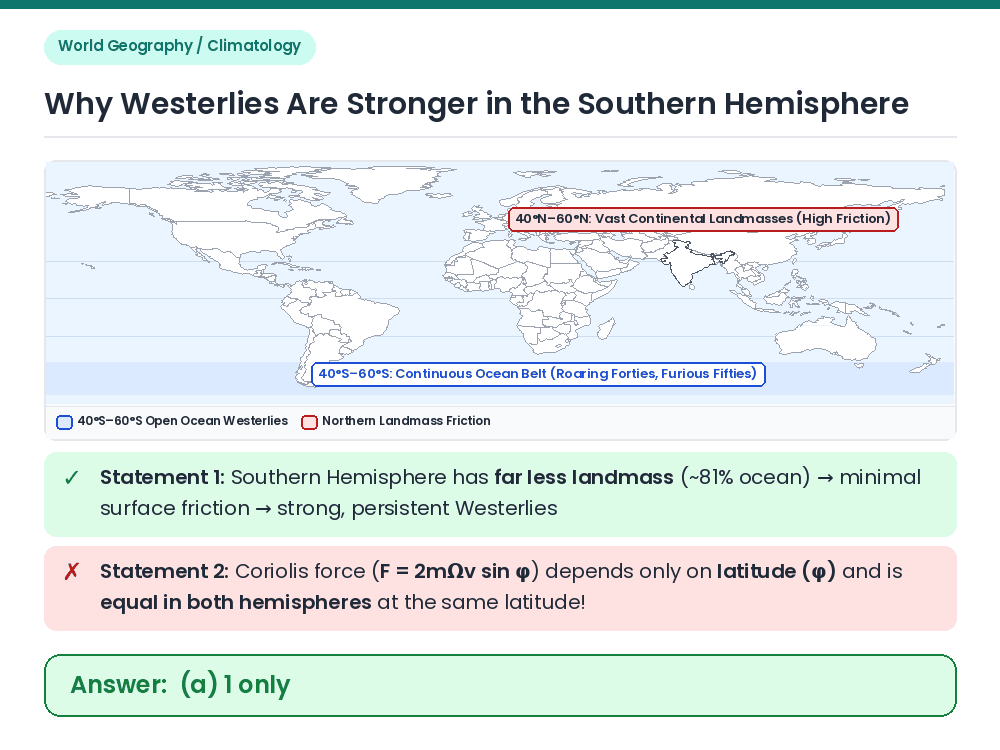
Westerlies in southern hemisphere are stronger and persistent than in northern hemisphere. Why ? 1. Southern hemisphere has less landmass as compared to northern hemisphere. 2. Coriolis force is higher in southern hemisphere as compared to northern hemisphere. Which of the statements given above is/are correct ?
Show answer & explanationShow explanation
Answer: (A) 1 only
Analyze Statement 1 — Land-Sea distribution: In the Northern Hemisphere, the mid-latitude belt (35°N–65°N) is dominated by vast continental landmasses and mountain ranges (North America and Eurasia), which create heavy frictional drag and thermal disruptions. In contrast, the Southern Hemisphere has very little landmass between 40°S and 60°S (almost continuous ocean), allowing the Westerlies to blow uninterrupted with great speed and persistence (known to sailors as the 'Roaring Forties', 'Furious Fifties', and 'Screaming Sixties'). Statement 1 is correct. Analyze Statement 2 — Coriolis Force formula: The magnitude of the Coriolis acceleration is 2Ωv sin(φ), where Ω is Earth's angular velocity and φ is the latitude. Since sin(φ) is identical at the same latitude in both the Northern and Southern Hemispheres (zero at the Equator and maximum at both Poles), Coriolis force is NOT higher in the Southern Hemisphere. Statement 2 is incorrect. Related Facts: • Because the Southern Hemisphere between 40°S and 60°S is ~81% open ocean with minimal continental friction, the Westerlies blow with great strength and persistence ('Roaring Forties', 'Furious Fifties', and 'Screaming Sixties'). • The Coriolis force (F = 2mΩv sin φ) depends only on latitude (φ) and wind speed (v), so it is equal in magnitude at the same latitude in both hemispheres. Correct Answer: (a) 1 only