Civil Services Examination · Question 96
Consider the following statements : 1. Biodiversity is normally greater in the lower latitudes as compared to the higher latitudes. 2. Along the mountain gradients, biodiversity is normally greater in the lower altitudes as compared to the higher altitudes. Which of the statements given above is/are correct ?
Show answer & explanationShow explanation
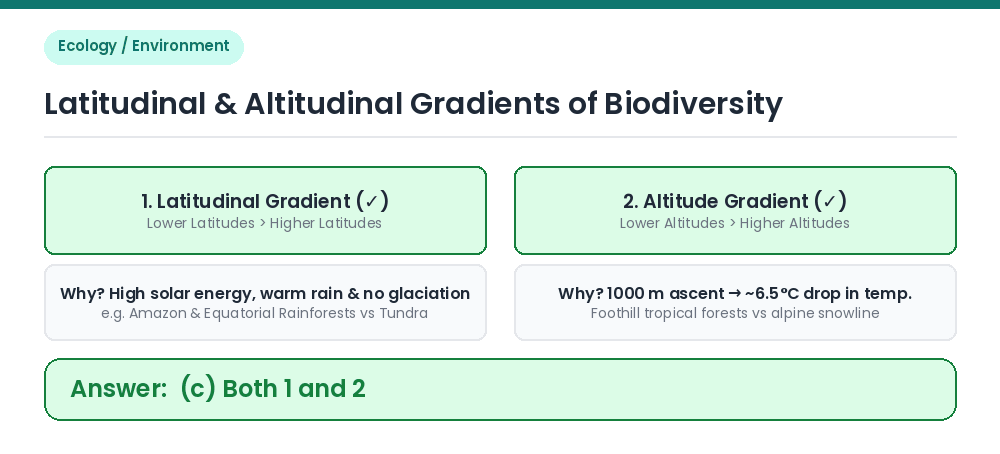
Answer: (C) Both 1 and 2
Analyze Statement 1 — Latitudinal Diversity Gradient: Species richness generally decreases as we move from the Equator (lower latitudes, 0°–23.5°) toward the Poles (higher latitudes, 66.5°–90°), because tropical lower latitudes receive higher solar energy, abundant rainfall, and have experienced long evolutionary stability without Pleistocene glaciation. Statement 1 is correct. Analyze Statement 2 — Altitudinal Diversity Gradient: Along mountain slopes, ascending to higher altitudes decreases temperature (at the normal lapse rate of ~6.5°C per 1,000 m), lowers atmospheric pressure/oxygen, and shortens the growing season. Consequently, biodiversity is normally greater at lower altitudes (warm, moist foothills) than at higher alpine altitudes. Statement 2 is correct. Related Facts: • The Latitudinal Diversity Gradient (LDG) is the ecological pattern whereby species richness increases from the poles (high latitudes) toward the Equator (low latitudes) due to high solar energy, warm temperatures, and evolutionary stability. • Similarly, along mountain slopes (altitudinal gradient), temperature drops by ~6.5°C per 1,000 m ascent, so species diversity is normally higher at lower altitudes than at freezing high altitudes. Correct Answer: (c) Both 1 and 2