Civil Services Examination · Question 97
The Brahmaputra, Irrawady and Mekong rivers originate in Tibet and flow through narrow and parallel mountain ranges in their upper reaches. Of these rivers, Brahmaputra makes a "U" turn in its course to flow into India. This "U" turn is due to
Show answer & explanationShow explanation
Answer: (B) Syntaxial bending of geologically young Himalayas
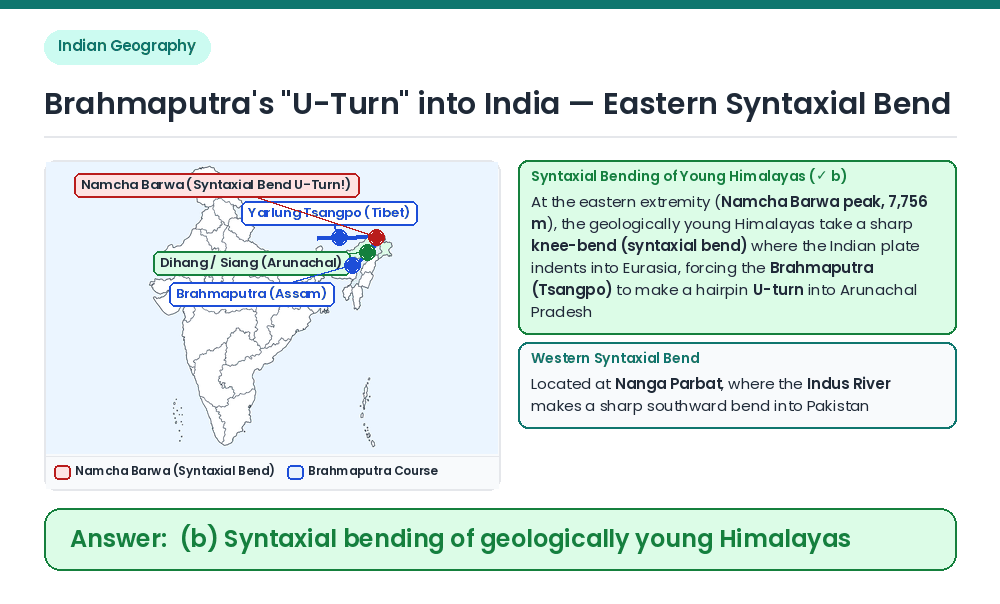
Understand the Eastern Syntaxial Bend of the Himalayas: The geologically young Himalayan mountain chain terminates abruptly at two sharp knee-like geological bends called 'Syntaxial Bends' — the Western Syntaxial Bend near Nanga Parbat and the Eastern Syntaxial Bend near Namcha Barwa (7,756 m), caused by the tectonic indentation of the Indian Plate against the Eurasian Plate. How it causes the Brahmaputra's U-turn: Flowing eastward across southern Tibet as the Yarlung Tsangpo, the river encounters the acute syntaxial bending of the Himalayas around Namcha Barwa, where it cuts a deep gorge (Dihang Gorge) and makes a sharp hairpin 'U-turn' to enter Arunachal Pradesh in India as the Siang/Dihang. Related Facts: • The Himalayas terminate sharply at two knee-bend geological structures called Syntaxial Bends: the Western Syntaxial Bend at Nanga Parbat (where the Indus cuts a gorge) and the Eastern Syntaxial Bend at Namcha Barwa (where the Brahmaputra/Yarlung Tsangpo makes a U-turn). • After taking its U-turn around Namcha Barwa (7,756 m), the Brahmaputra enters Arunachal Pradesh as the Siang/Dihang river. Correct Answer: (b) Syntaxial bending of geologically young Himalayas