Civil Services Examination · Question 100
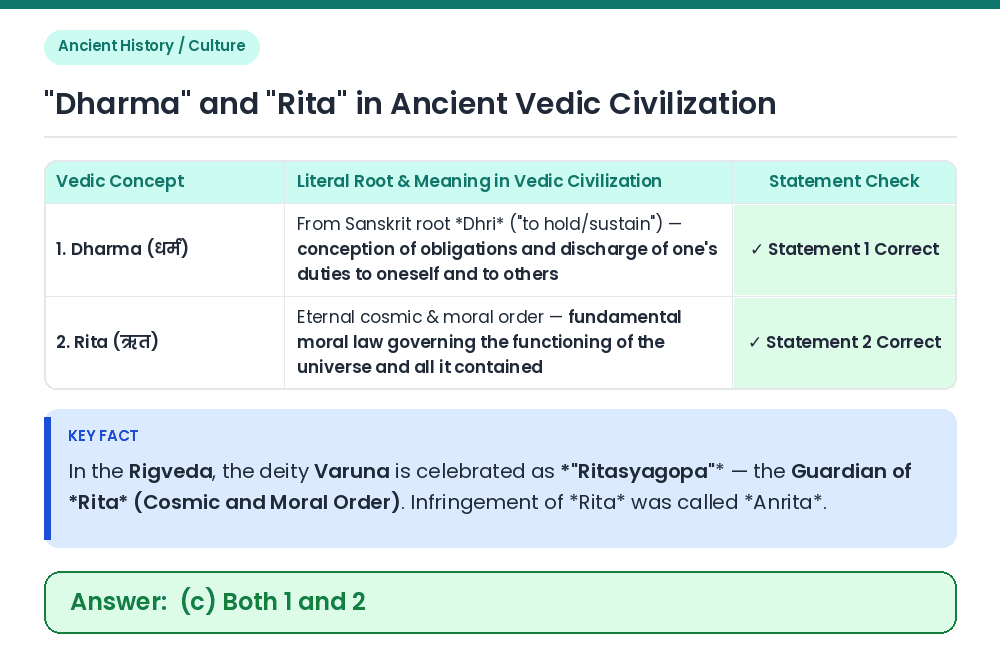
The "dharma" and "rita" depict a central idea of ancient Vedic civilization of India. In this context, consider the following statements : 1. Dharma was a conception of obligations and of the discharge of one's duties to oneself and to others. 2. Rita was the fundamental moral law governing the functioning of the universe and all it contained. Which of the statements given above is/are correct ?
Show answer & explanationShow explanation
Answer: (C) Both 1 and 2
Analyze Statement 1 — Dharma: Derived from the Sanskrit root 'dhri' (meaning 'to uphold, sustain, or support'), Dharma in the Vedic and post-Vedic tradition signified the conception of moral/social obligations and the righteous discharge of one's duties toward oneself, family, society, and the cosmos. Statement 1 is correct. Analyze Statement 2 — Rita: In the Rigveda, 'Rita' represented the eternal cosmic, physical, and moral law that governed the regular functioning of the universe — the motion of the Sun, Moon, stars, seasons, and moral conduct of gods and humans alike. Statement 2 is correct. Related Facts: • In Rigvedic religion, the god Varuna was revered as 'Ritasyagopa' (the upholder/guardian of Rita). • The violation or negation of Rita (cosmic and moral order) in Vedic literature was termed 'Anrita' (falsehood/disorder). Correct Answer: (c) Both 1 and 2