Civil Services Examination · Question 57
A deadlock between the Lok Sabha and the Rajya Sabha calls for a joint sitting of the Parliament during the passage of 1. Ordinary Legislation 2. Money Bill 3. Constitution Amendment Bill Select the correct answer using the codes given below :
Show answer & explanationShow explanation
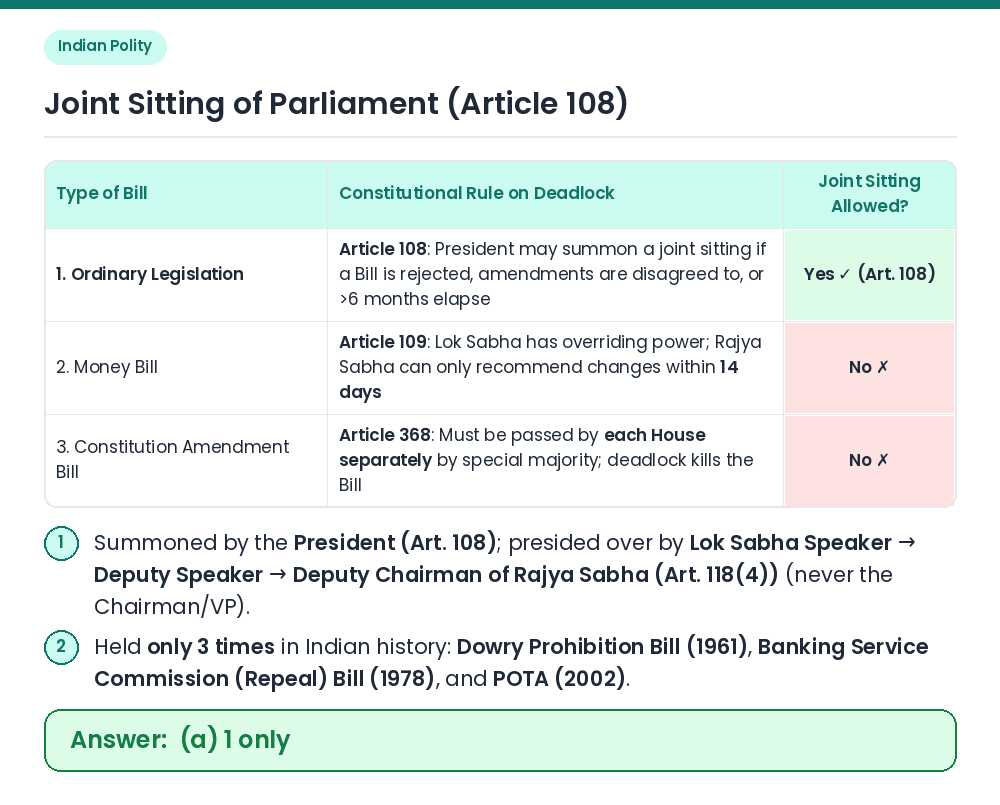
Answer: (A) 1 only
Given / Concept: Article 108 of the Constitution provides for a joint sitting of both Houses of Parliament to resolve a legislative deadlock. Statement 1 Analysis: A joint sitting under Article 108 applies only to Ordinary Bills and Financial Bills (Categories I and II under Article 117) when one House rejects the Bill, disagrees on amendments, or keeps it pending for more than 6 months ⇒ Statement 1 is correct. Statements 2 & 3 Analysis: Article 108 explicitly excludes Money Bills (where Lok Sabha prevails after 14 days under Article 109) and Constitution Amendment Bills (which must be passed by each House separately by special majority under Article 368) ⇒ Statements 2 and 3 are incorrect. Result: A joint sitting can be called only for Ordinary Legislation (1 only). Related Facts: Key rules & history of Joint Sittings (Articles 108 & 118): • Presiding Officer Hierarchy (Art. 118(4)): Speaker of Lok Sabha → Deputy Speaker of Lok Sabha → Deputy Chairman of Rajya Sabha → Member chosen by the sitting (Note: Chairman of Rajya Sabha / Vice-President never presides as he is not a member of either House). • Majority Required: Decided by a simple majority of the total number of members of both Houses present and voting. • Three Historical Instances: Dowry Prohibition Bill (1961), Banking Service Commission (Repeal) Bill (1978), and Prevention of Terrorism Bill (POTA, 2002). Correct Answer: (a) 1 only