Civil Services Examination · Question 60
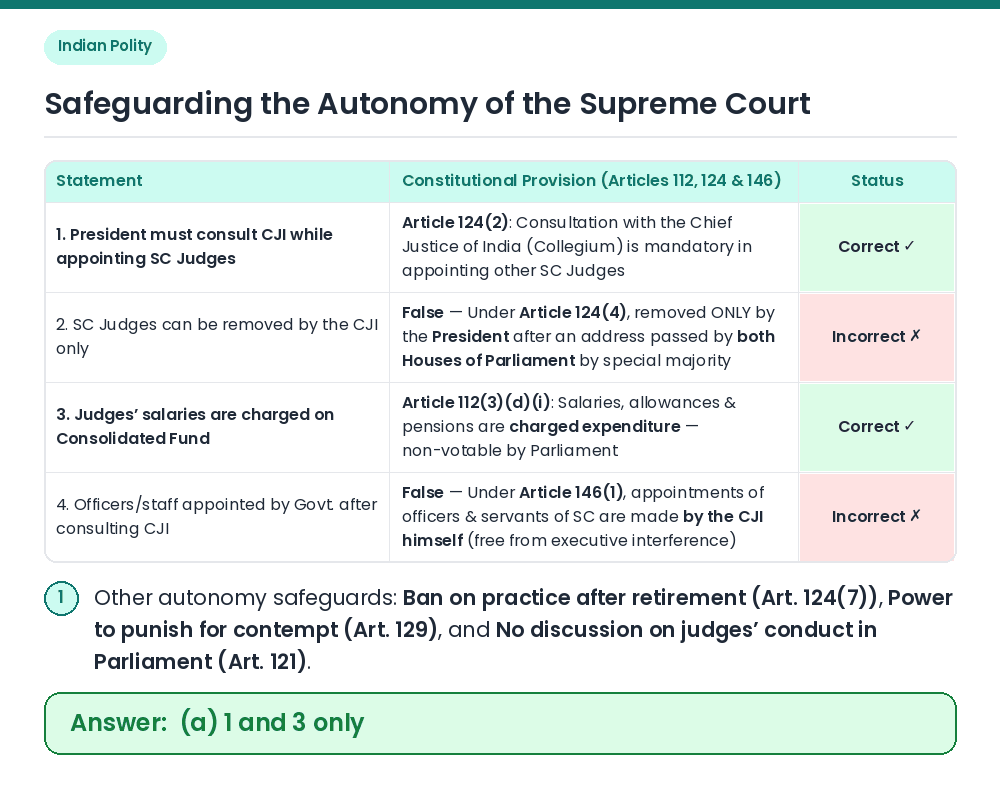
What is the provision to safeguard the autonomy of the Supreme Court of India? 1. While appointing the Supreme Court Judges, the President of India has to consult the Chief Justice of India. 2. The Supreme Court Judges can be removed by the Chief Justice of India only. 3. The salaries of the Judges are charged on the Consolidated Fund of India to which the legislature does not have to vote. 4. All appointments of officers and staffs of the Supreme Court of India are made by the Government only after consulting the Chief Justice of India. Which of the statements given above is/are correct?
Show answer & explanationShow explanation
Answer: (A) 1 and 3 only
Given / Concept: The Constitution contains strict institutional safeguards (Articles 121–146) to ensure the independence of the Supreme Court from the Executive and Legislature. Statements 1 & 3 Analysis: Under Article 124(2), the President must consult the Chief Justice of India (CJI / Collegium) when appointing Supreme Court judges (1), and under Article 112(3)(d), the salaries, allowances, and pensions of Supreme Court judges are 'charged' on the Consolidated Fund of India and are not subject to parliamentary vote (3) ⇒ Statements 1 and 3 are correct. Statements 2 & 4 Analysis: Supreme Court judges are removed by an order of the President passed after an address by both Houses of Parliament with special majority, not by the CJI (2, Art. 124(4)); and under Article 146(1), appointments of officers and servants of the Supreme Court are made by the CJI himself (or a judge/officer directed by him), not by the Government (4) ⇒ Statements 2 and 4 are incorrect. Result: Statements 1 and 3 only are correct. Related Facts: Additional Constitutional Safeguards for Supreme Court Independence: • Article 121 (Immunity from Criticism): No discussion can take place in Parliament regarding the conduct of any Supreme Court or High Court judge in the discharge of his duties, except upon a removal motion. • Article 124(7) (Post-Retirement Ban): Retired Supreme Court judges are prohibited from pleading or acting in any court or before any authority within the territory of India. • Article 138 (Jurisdiction Security): Parliament can only enlarge, never curtail, the jurisdiction and powers of the Supreme Court. Correct Answer: (a) 1 and 3 only