Civil Services Examination · Question 63
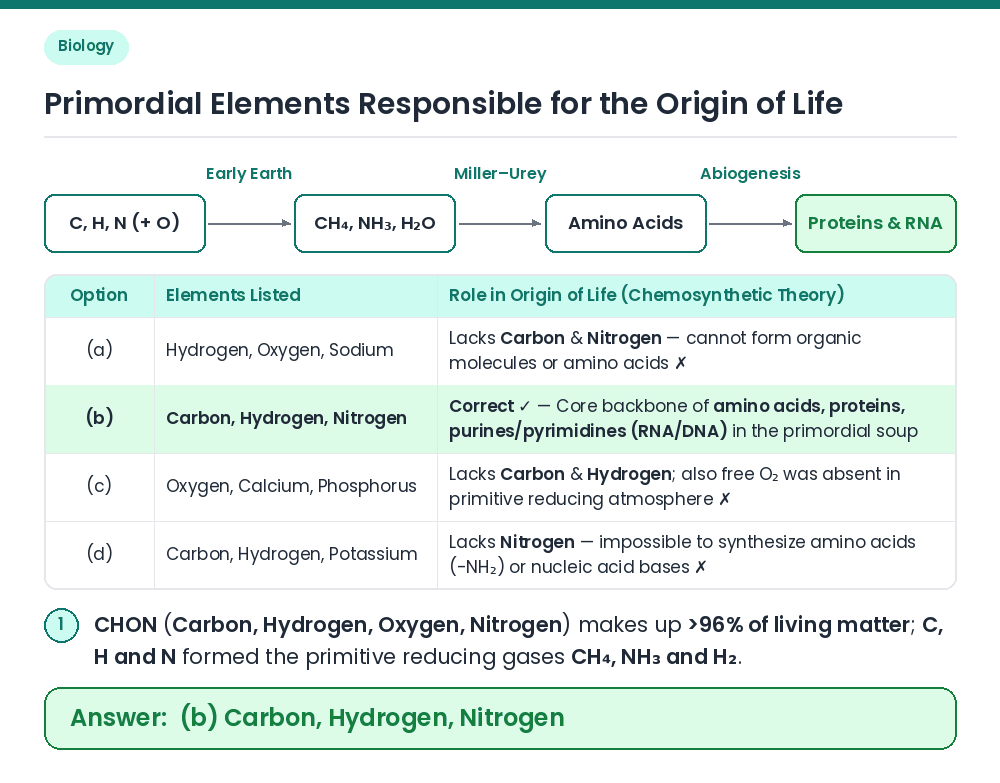
Which one of the following sets of elements was primarily responsible for the origin of life on the Earth?
Show answer & explanationShow explanation
Answer: (B) Carbon, Hydrogen, Nitrogen
Given / Concept: According to the Oparin–Haldane chemosynthetic theory of the origin of life, the first organic molecules (amino acids, sugars, nitrogenous bases) formed in Earth's primitive reducing atmosphere. Elemental Requirement: Every amino acid (building block of proteins) and nucleotide base (building block of RNA/DNA) requires Carbon (C), Hydrogen (H), and Nitrogen (N) (along with Oxygen) ⇒ Option (b) 'Carbon, Hydrogen, Nitrogen' is the only set containing all three essential elements. Elimination of Other Options: Options (a) and (c) lack Carbon (without which organic chemistry cannot exist), and option (d) lacks Nitrogen (without which amino acids and nucleic acids cannot form). Result: Carbon, Hydrogen, and Nitrogen were primarily responsible for the origin of life on Earth. Related Facts: Key facts on the Origin of Life (Abiogenesis): • Oparin–Haldane Hypothesis (1924/1929): Proposed that life arose from non-living organic molecules ('prebiotic soup') in a reducing atmosphere rich in CH₄ (methane), NH₃ (ammonia), H₂, and water vapour (with no free O₂). • Miller–Urey Experiment (1953): Stanley Miller and Harold Urey passed electric sparks (simulating lightning) through a mixture of CH₄, NH₃, H₂, and H₂O vapour and successfully synthesized amino acids. • Six Core Elements of Life (CHNOPS): Carbon, Hydrogen, Nitrogen, Oxygen, Phosphorus, and Sulphur make up ~98% of all living biomass. Correct Answer: (b) Carbon, Hydrogen, Nitrogen