Civil Services Examination · Question 66
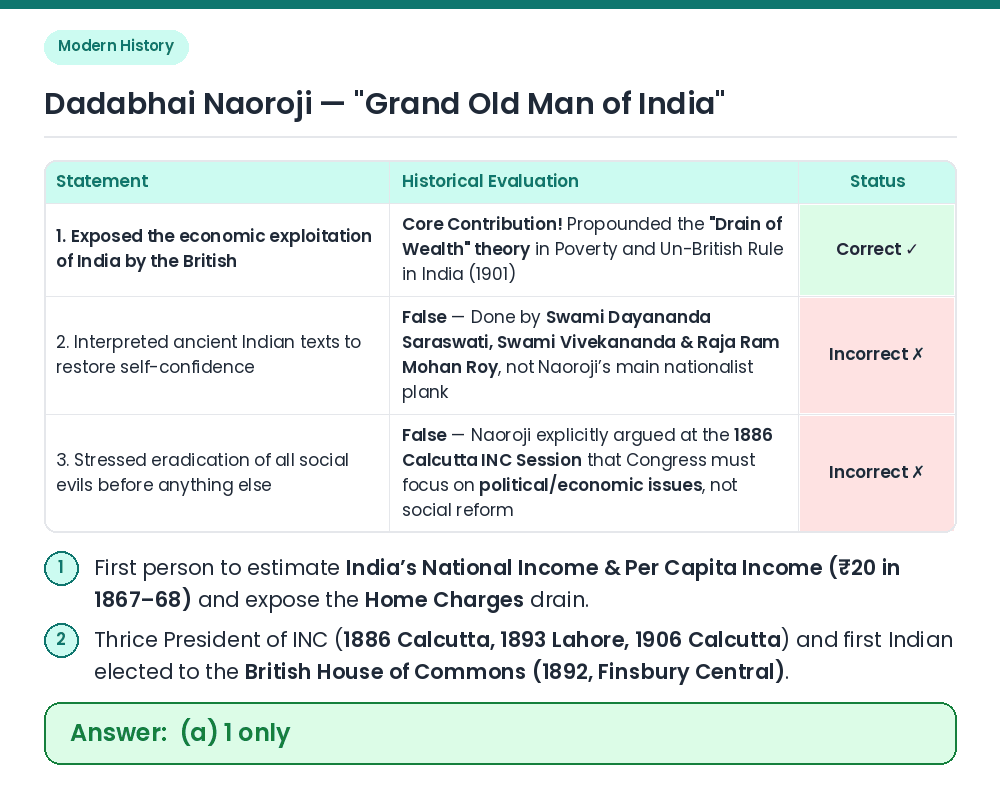
Consider the following statements : The most effective contribution made by Dadabhai Naoroji to the cause of Indian National Movement was that he 1. exposed the economic exploitation of India by the British 2. interpreted the ancient Indian texts and restored the self-confidence of Indians 3. stressed the need for eradication of all the social evils before anything else Which of the statements given above is/are correct?
Show answer & explanationShow explanation
Answer: (A) 1 only
Given / Concept: Dadabhai Naoroji (1825–1917), revered as the 'Grand Old Man of India', was the foremost economic thinker of the early nationalist phase. Statement 1 Analysis: His most effective and enduring contribution to the Indian National Movement was formulating the 'Drain of Wealth' theory (first presented in his 1867 paper 'England's Debt to India' and compiled in his 1901 book 'Poverty and Un-British Rule in India'), which scientifically exposed how Britain was economically bleeding India ⇒ Statement 1 is correct. Statement 2 & 3 Analysis: Interpreting ancient Hindu/Vedic texts to restore cultural self-confidence was the contribution of leaders like Swami Vivekananda and Dayananda Saraswati (2); and far from stressing social evils before political work, Naoroji declared in his 1886 Congress presidential address that the Congress should focus purely on political and economic questions (3) ⇒ Statements 2 and 3 are incorrect. Result: Only statement 1 is correct. Related Facts: Key facts about Dadabhai Naoroji: • Organizations Founded: London India Society (1865) and East India Association (1866 in London); co-founder of the Indian National Congress (1885). • British MP (1892): First Indian elected to the British House of Commons from Finsbury Central on a Liberal Party ticket; led to the appointment of the Welby Commission (1895) on Indian expenditure. • Swaraj Demand (1906): As President of the 1906 Calcutta Congress session, he was the first to officially declare 'Swaraj' (self-government) as the goal of the Indian National Congress. Correct Answer: (a) 1 only